On December 3, 2024 Governor Michelle Lujan Grisham announced plans to move the New Mexico State Fair to a different location and redevelop the 236 acre State Fair property into a mixed-use development. On March 21, 2025, in response to the Governor’s announcement to redevelop or move the state fair, the New Mexico legislature passed legislation creating the “State Fairgrounds District.” It is a board that has redevelopment funding authority over the existing State Fair grounds area. The board has no authority to move the fairgrounds. It will be up to the New Mexico State Fair Commission to make the decision to move the fairgrounds.
The State Fairgrounds District Board is empowered to raise property taxes and issue up to $500 million in bonds to fund future development of the property, to make improvements to repurpose the property. According to the legislation, the board will govern the development of the district for six years.
Voting members of the State Fairgrounds District Governing Board are:
- Governor Michelle Lujan Grisham, chairperson
- Albuquerque Mayor Tim Keller
- Senator Mimi Stewart, Senate President Pro-Tempore, International District, #17
- State Representative Janelle Anyanonu whose district the fair grounds is located
- City Councilor Nichole Rogers whose district the fair grounds is located
- County Commissioner Adriann Barboa whose district the fair grounds is located
- Peter Belletto, President, District 6 Neighborhood Coalition
STANTEC CONSULTING SERVICES, INC
On June 18, the state General Services Department announced that a $844,433 contract with Stantec Consulting Services Inc. was entered into with the State for Stantec to create a master plan for repurposing the 236-acre tract of land that has since 1938 hosted the annual New Mexico State Fair. Stantec has agreed to develop a master that will make suggestions for the land’s use. According to the Governor’s Office the master plan is expected to be completed by next spring. Once approved, work on the project could begin next year and be completed by fall 2029.
STATE FAIRGROUNDS DISTRICT GOVERNING BOARD REVIEWS THREE CONCEPT PLANS
On December 8, the Governor’s Office released to the public three concept plans prepared by Stantec for the development of the State Fair property. On December 11, the State Fair District Board held its monthly meeting. The meeting was chaired by Governor Lujan Grisham and attended by board members Senator Mimi Stewart, County Commissioner Adriann Barboa, City Councilor Nichole Rogers and Dr. Peter Belletto. Not attending were board members Mayor Tim Keller and State Representative Janelle Anyanuon. The main agenda item was a presentation by the Stantec Consulting Services of three Concept Plans developed and designed over the past few months for the State Fairgrounds.
According to Stantec, each of the three Concepts Plans were based on input from the community. The community input included the “desire to create safe, welcoming, walkable neighborhoods, opportunities for economic prosperity for area residents, increased nature and green spaces, affordable family-friendly amenities, improved transportation, pedestrian safety, and connectivity, and increased environmental sustainability.” It was emphasized that the three Concept Plans are NOT final and are designed to solicit discussion and public input on the different elements and to envision how elements would work together to reimagine a successful Fairgrounds
CONCEPT PLANS PRESENTED TO BOARD
All three Concept Plans call for major redevelopment of the Southwest corner of the property at San Pedro Drive and Central Avenue. The state is already moving to acquire for $22 million the property with the issuance of bonds to finance the acquisition of the properties either by negotiations with the property and business owners or by litigation and adverse condemnation.
Two of three designs keep the fair where it is but on a reduced footprint, and they share many of the same amenities, though they differ in size and quantity.
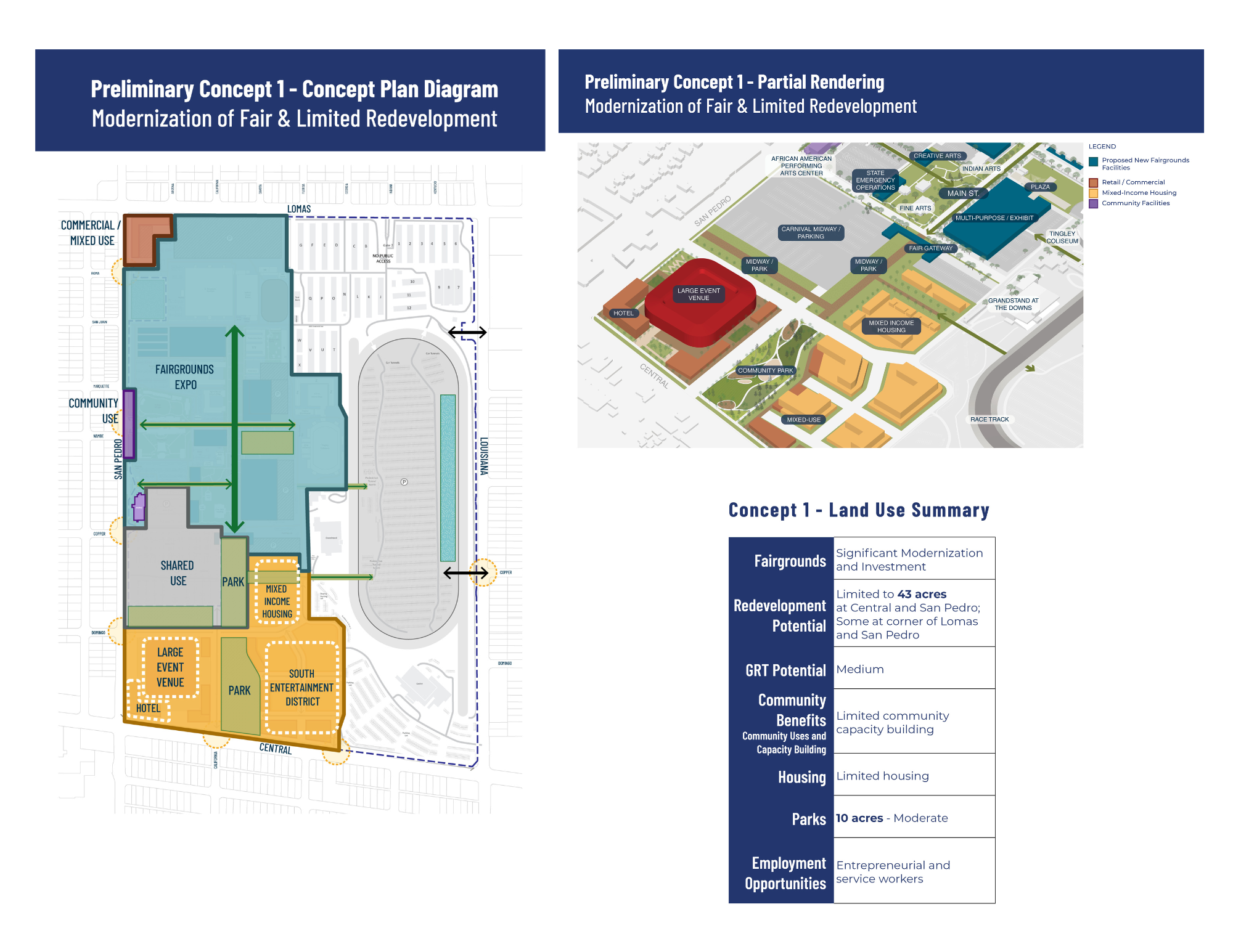
Concept One maintains the midway, using it as a large parking lot for the rest of the year, but adds a new exhibition space, a 10-acre park, affordable housing, an event center and a hotel to the grounds’ south side.
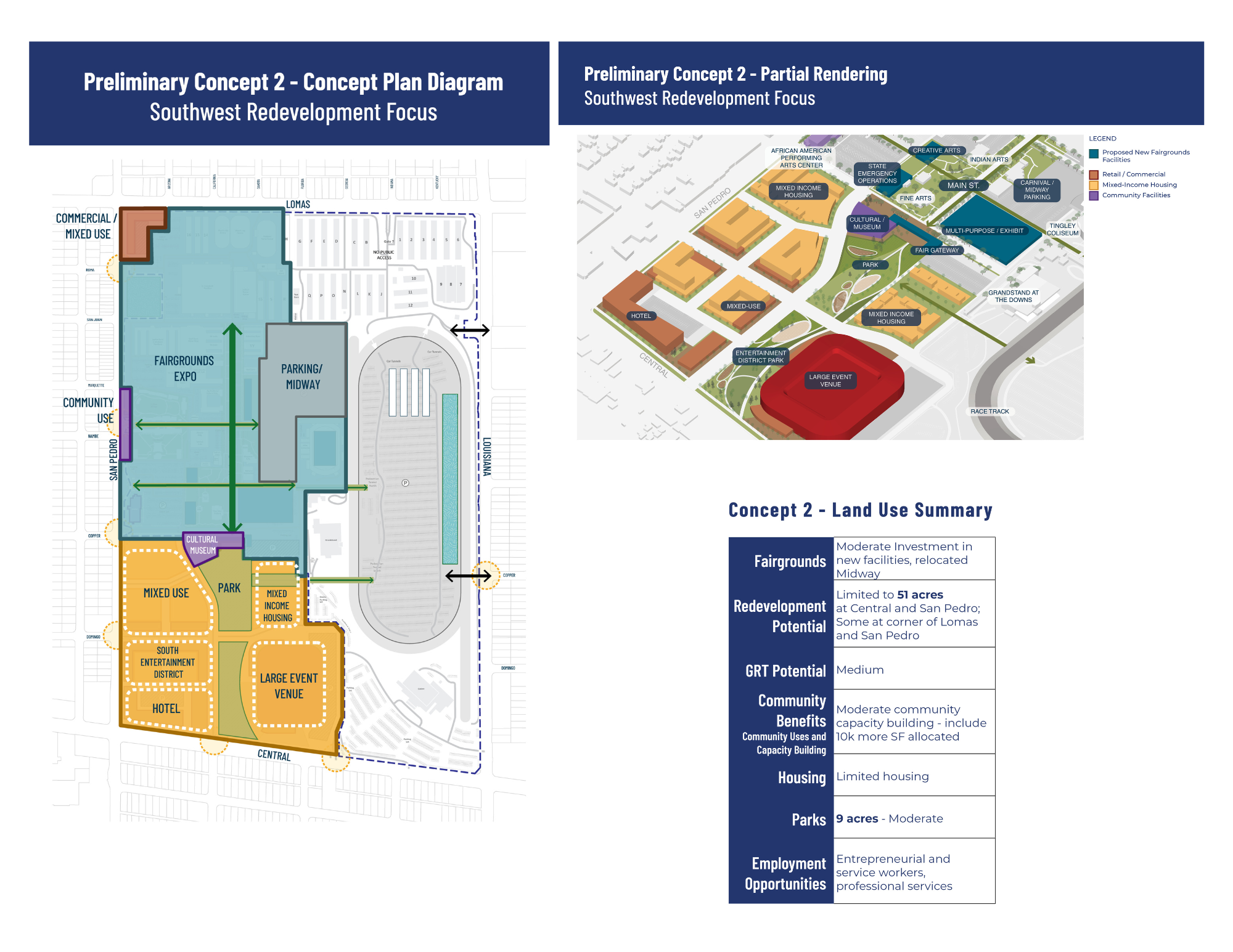
Concept Two significantly reduce the midway while new amenities like an event center would take up more space. The second design also includes space for a museum.
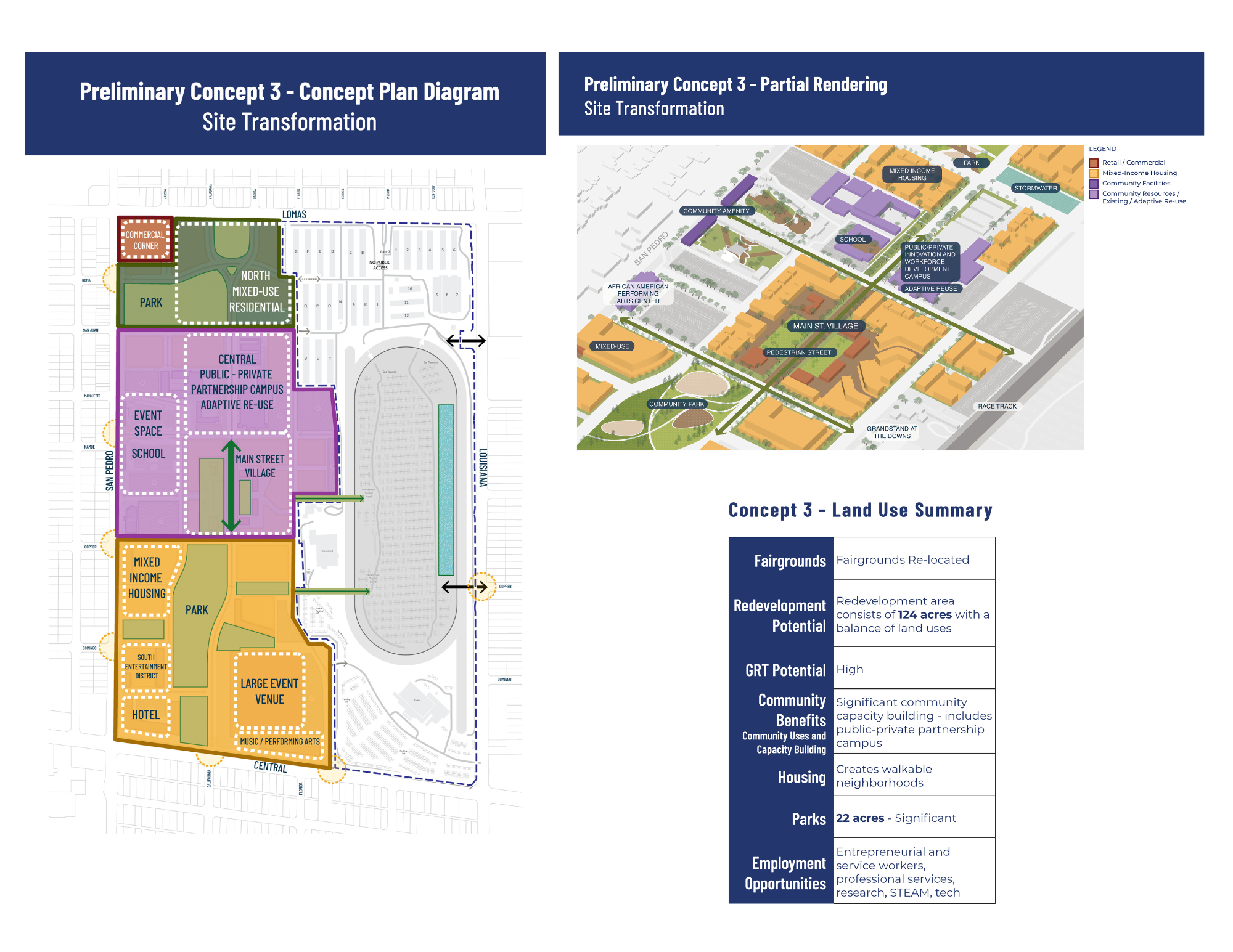
Concept Three is the most draconian of the three plans. It would require the fairgrounds to be completely relocated. On top of the amenities present in the previous designs, this design would include “hundreds” of housing units, a school, workforce development center and two parks that would add 20 acres for park areas.
Regardless of which of the three concept designs the state chooses, all three share some similarities, including a hotel, event venue, a new park, mixed-income housing and retail space. The tree-lined Main Street is preserved in all three designs.
All three of the concept plans place a major emphasis and dedicate large portions of the State Fair property to affordable housing and large park areas. The mixed used housing would include apartments, condominiums and town homes for low income or subsidized housing.
THREE CONCEPT PLANS SUMMARIZED
Concept Plan 1 maintains the State Fair on the Fairgrounds. It opens the space up to the community by creating 10 acre public park, and creates an entertainment district with a large event venue and mixed housing. The redevelopment is limited to the 43 acres in the Southwest corner and has Gross Receipts Tax (GRT) potential to support infrastructure and development. The space for housing is limited and there would be limited employment opportunities, mostly for service workers. Concept 1 preserves and enhances the existing Fairgrounds footprint, upgrading facilities while adding transformative new amenities. Those new amenities would include:
- State-of-the-art multipurpose event venue
- Mixed-use entertainment district
- A modern exhibition hall
Click here for link to review the Concept 1 one plan.
Concept Plan 2 reimagines the State Fair and adjusts its footprint. It features a larger entertainment district complete with a venue and a hotel, as well as mixed use space, a slightly smaller 9 acre public park, and limited housing. The redevelopment potential is 51 total acres, including the Southwest corner off of San Pedro and Central that is now private property to be acquired, and some space on the corner of Lomas and San Pedro. This concept offers a moderate amount of community benefit potential and additional employment opportunities in entrepreneurial fields and professional services. Concept 2 relocates the State Fair Midway to make room for the development of “an expanded live-work-play neighborhood.” It proposes :
- An arena complex
- A mixed-use entertainment district
- A multi-purpose exhibition hall for conferences and community events
- A nine-acre public park
Click here for link to review Concept 2 .
Concept Plan 3 proposes the State Fair be relocated, completely transforming the site while maintaining the Fairgrounds Main Street. The Concept 3 plan has an expansive 22 acre public park, an entertainment district, education and workforce training space, and mixed housing. The redevelopment potential is 124 acres and offers a balance of land uses making the Gross Receipts Tax (GRT) potential high and the community benefits significant. The space for housing is large and designed as “walkable neighborhoods”. The employment potential include opportunities for entrepreneurs, service workers, professional services, research, STEM, and technology. Concept 3 would completely overhaul the entire state fair area and build the following in the fairgrounds’ current footprint:
- “Hundreds of homes”
- “An innovation hub focused on next-generation technology”
- A large event venue
- “A walkable main street village”
- “More than 20 acres of park and green space.”
Click here for link to review Concept 3 .
The link to the Fair Grounds “Reimagine” web site is here:
GOV. MLG EMBRACES CONCEPT PLAN TO MOVE STATE FAIR
Immediately after the November 11 State Fair District Board meeting, Governor Lujan Grisham was interviewed by KRQE News 13. The governor said she favors the third Concept Plan, which is the most aggressive concept plan that proposes moving the state fair. The Governor said she is still waiting for cost estimates before making a final decision. The governor said this:
“I want a whole new footprint in the middle, the center of historic Albuquerque. I prefer option 3. …This state needs and deserves a robust state fair property.
Governor Lujan Grisham said she shares frustrations about crime in the area and criticized what she called a “lack of leadership and inadequate response from local officials and first responders.” The Governor said this:
“When I look at the outcomes here, I am feeling very frustrated by the lack of progress. … I think this community should demand that we are all working together. … I think redevelopment has a real impact. … Prosperity makes opportunity.”
The Governor argued that redevelopment could help shift the neighborhood’s trajectory.
AREA RESIDENTS RAISE CONCERNS
The decision to redevelop the area, which Gov. Michelle Lujan Grisham announced over a year ago, has drawn both praise and down right hostility and anger from area residents. The 236-acre tract of land in northeast Albuquerque has hosted the annual State Fair since 1938, but the state and its consultants say that the area is “underutilized” and its infrastructure is crumbling and that the State Fair Commission is saying the fair “has outgrown the property” justifying moving the fair to a new location.
The Governor’s Office called the redevelopment a “once-in-a-generation opportunity”. Not everyone agrees with the Governor, especially those who live in the International District itself. Many Area residents have argued in public planning meetings that the fairgrounds should stay for any number of reasons, ranging from concerns over crime to fears of gentrification.
While Stantec representatives emphasized the three Concept plans are still conceptual, the December 11 meeting drew a mixture of optimism and skepticism from area residents who attended the meeting and who were interviewed by the media after the meeting. Audience members were not given an opportunity to address the board during the meeting. Many areas residents who have attended past State Fair District meeting and who have attended citizen input meetings with Stantec and responded to Stantec surveys have raised major concerns about crime, drug activity and homelessness in the International District surrounding the fairgrounds.
Albuquerque resident Wally Book told KOB 4 News this:
“We can dress up just this block, but until we address the surrounding area it’s not going to take hold.”
Another resident, Dave Kailer, questioned whether a proposed park could thrive in the area and said this:
“You know what is going to happen to that park if you put it in the war zone? It will turn into a homeless park, let’s face it. … I don’t want to be ugly about it or negative about it. I’m just being realistic.”
Pete Dinelli, who has lived directly North of the State Fairgrounds for over 40 years, told KRQE News 13 this:
“The State Fair District Board is attempting to use the State Fair property to solve all the crime and economic problems of the International District. Until you reduce crime and homeless on Central and in the International District itself, redevelopment of the State Fair property will fail.”
PUBLIC FEEDBACK AND FUTURE MEETINGS
The public can submit feedback on the designs online at fairgroundsdistrict.nm.gov or in-person at the final public input meeting planned for early January. Click here for a link to the survey.
The State Fair Board will continue gathering public input before selecting the preferred option. The board plans to meet in either January or February to go over each plan in more detail. Any final plan would require approval from the State Board of Finance and the Legislature.
Links to relied upon or quoted news sources are here:
https://www.fairgroundsdistrict.nm.gov/
https://www.kob.com/new-mexico/state-leaders-review-plans-for-state-fairgrounds/
https://www.abqjournal.com/news/article_335683f7-894c-48bb-9451-dc4c761472fc.html
STRONG OPPOSITION TO MOVING STATE FAIR IGNORED BY GOVERNOR
Governor Lujan Grisham’s proposal to moving the state fair has been met with strong opposition and resentment from area residents of Albuquerque’s International District, which has dealt with rampant and rising drug use and homelessness in recent years. The proposed redevelopment has proven controversial with residents in the International District who say that they are concerned the funding will do little to help the neighborhood, will uproot the historic annual State Fair and will, like past efforts at fairgrounds redevelopment, be a flop.
On February 26, 2025, Bernalillo County Government held meeting to discuss and provide information on a proposed Tax Increment Development District (TIDD) for the New State Fairgrounds. Upwards of 200 residents attended. Most if not all of the public present for the February 26 meeting were very hostile to moving the state fair and spoke out against moving the state fair to another location.
Audience members were given the opportunity to speak after the presentation on the proposed Tax Increment District (TIDD). Audience members said that the City and the Mayor Keller Administration have been a total failure in cleaning up Central and the city has failed to address crime and the homeless crisis on Central. Audience members argued that before anything is spent on improving or moving the Fair Grounds, money would be better spent cleaning up Central, dealing with the homeless, drug addicted and mentally ill and providing them with services to get them off the streets.
COMMENTARY AND ANALYSIS
During the July 2 State Fair District meeting, Governor Lujan Grisham signaled that she was backing off on moving the fairgrounds and said that the State Fair might not have to find a new venue. Lujan Grisham said this in particular signaling a change is her stance:
“I want to be really clear about that, because you’ll notice I didn’t say a plan to move the State Fair.”
It’s downright laughable and pathetic that Governor Lujan Grisham has now embraced Concept 3 as her preferred plan. It is painfully obvious that Governor Lujan Grisham is simply ignoring the public opposition to moving the State Fair knowing that she is a lame duck with only a year left before her term ends to accomplish a legacy project she wants and to be rubber stamped by her appointed State Fair District Board and State Fair Commission. This coming from the Governor who went out of her way and cautioned just a few months ago that no final decision had been made.
Concept Plan 3 is the most draconian of the 3 Concept Plans with the ultimate goal of moving the State Fair ground. Governor Lujan Grisham said she would like to see the project break ground before she leaves office at the end of next year. Her words and action now confirm what she has said and what she has known all along and that is the Governor is hell bent on moving the state fair over strong public opposition and is rushing the project to have a legacy project before she leaves office in a year.
A SHAM BOARD
The biggest sham is that Governor’s appointed State Fair District Board and Stantec are going along with the Governors efforts to move the State Fair so that all of its property can be dedicated to reviving and benefiting the International District. The Governor and her board have essentially ignored the needs and concerns of neighborhoods and businesses to the West, North and East of the Fairgrounds. Five out of the seven State Fair District Board members are elected officials of the International District with the President of the District 6 Coalition of Neighborhoods all in the International District.
GOVERNOR BLAMES LOCAL LAW ENFORCEMENT AND LEADERSHIP
What is so very offensive is Governor Lujan Grisham blaming local law enforcement and local leadership for failing to deal with crime and the unhoused crisis in the International District. She then turns around in the same breath to argue that there is a need to “re dedicate” the state fair property to solve those problems. It is clear the State Fairgrounds redevelopment is being promoted by the Governor and her appointed State Fair District Board as being some sort of a great panacea to solve the problems of crime, the homeless, lack of affordable housing and lack of economic development in the International District. It will not.
The Fair Grounds cannot be characterized as the cause or as a magnet for crime within the International District. No statistics have been presented to the State Fair board on the extent of crime that occurs on the State Fairgrounds itself. No discussion has been held or proof offered as to what extent the State Fair grounds is responsible for crime in the International District.
The International District, which is bordered by Central South of the State Fairgrounds has had for decades some of the highest violent crime, property crime and drug offense rates, so much so that it was at one time referred to as the WAR ZONE until it was officially renamed the International District, but the renaming had no impact on the trajectory of the area. The International District continues to be plagued by high crime rates and now has become a magnet for the homeless with encampments constantly popping up and cleaned up by the city only to pop up again.
Crime and the unhoused is what is destroying private investment, job growth and small business development within in the International District. After all the millions are spent to redevelop the fairgrounds, to improve infra structure and traffic flow, building a park, adding public spaces and allowing businesses and low-income housing, the problems of high crime rates and the unhoused will remain the same in the International District because they have never been solved for decades. No businesses will want to relocate to the State Fair grounds after it is developed into commercial property, and it will become a magnet for crime and for the homeless, especially with parks.
AFFORABLE HOUSING
Efforts to address “affordable housing” continue to be a major target and goal for the State Fairgrounds District Board and is a very big part of the presentations made to the State Fair District Governing Board by Stantec. The three redevelopment Concept Plans for the property propose to commandeer a good portion of the Expo NM State Fair Property for affordable housing and it is as absurd as it gets.
The term affordable housing is about as misleading as it gets. It is a term often used by politicians, elected officials and developers to promote their own personal or political agendas. Simply put construction costs are consistent when it comes to housing and in today’s market are extremely high as are existing housing costs. When the term “affordable housing” is used by the politicians, elected officials and developer’s, what is meant is “subsidized government housing”.
Affordable housing or subsidized housing for low-income income earners is not the highest and best use of any portion of the 236 acres of prime property for development in the center of Albuquerque. It would put a small dent in the shortage of housing.
The highest and best use of the 236 acres of property is the State Fair itself and keeping it as Expo New Mexico and developing a year-round Entertainment District and to preserve the New Mexico State Fair and Expo New Mexico where it is now.
Efforts for affordable housing use for the State Fair grounds should be abandoned in that it would impair the overall goal and development of the property for projects that benefit the entire community as a whole and for public use.
PARKS WILL BECOME MAGNETS FOR CRIME AND THE HOMELESS
All three of the concept plans place a major emphasis and dedicate large portions of the State Fair property to park areas with access from Central or San Pedro to the parks. Concept One provides a 10-acre public park. Concept Two provides a 9-acre public park. Concept three provides for a 22-acre public park.
The reality of the city’s homeless crisis is that parks are notoriously magnets for crime and the unhoused. At this point, the State Fairgrounds, does not have a crime problem with the New Mexico State Police having primary law enforcement responsibility to calls for service. The lack of crime on the state fair property will no doubt change with parks.
Area resident Dave Kailer was absolutely correct when he was questioned whether a proposed park could thrive in the area and he said this:
“You know what is going to happen to that park if you put it in the war zone? It will turn into a homeless park, let’s face it. … I don’t want to be ugly about it or negative about it. I’m just being realistic.”
History tends to repeat itself over and over again especially when it comes to the homeless crisis. Governor Mitchell Lujan Grisham might as well dedicate any park on State Fair grounds property with public access as Coronado Park 2 in remembrance to Coronado Park which was closed by the city as a result of more than 125 unsheltered people taking over the park to camp and it becoming a hot bed for narcotic usage, trafficking illicit drugs and violent crime, including homicides and rapes. Coronado Park became a “de facto” city sanctioned homeless encampment thanks to Mayor Keller’s reluctance to do do anything about the unauthorized use of the park by the homeless and costing the city $50,000 to clean it up each month. Eventually, Keller declared Coronado Park as the most dangerous place in the state to be and ordered the park closed.
FINAL COMMENTARY
The Governor and her appointed State Fair District Board is attempting to use the State Fair property to solve all the crime, economic problems and lack of affordable housing of the International District. Until you reduce crime and homeless on Central itself and in the International District itself, redevelopment of the State Fair property as envisioned by the Governor and Stantec will fail and Governor Lujan Grisham will go down as the Governor who destroyed the State Fair for the sake of her ego.
Governor Michelle Lujan Grisham, Albuquerque Mayor Tim Keller, Senate Pro Tempore Mimi Stewart, State Representative Janelle Anyanonu, City Councilor Nichole Rogers and County Commissioner Adriann Barboa who are the elected officials and politicians on the “State Fairgrounds District Board” need to keep their greedy little hands off the State Fair grounds and abandon any effort to move it or dedicate it for affordable housing and parks. Simply put, the surrounding neighborhoods, businesses and their constituents want the State Fair to remain where it is. They need to listen for a change and knock it off pretending to be developers.
The links to related articles are here: