Three Preliminary Concept Plans For State Fair Property Presented To State Fair District Board; Governor MLG Embraces Concept Plan To Move State Fair; Gov. MLG Falsely Claims Redevelopment Of Property Will Revitalize International District’; Parks On Property Will Be Magnets For Crime And Homeless Encampments   

On December 3, 2024 Governor Michelle Lujan Grisham announced plans to move the New Mexico State Fair to a different location and redevelop the 236 acre State Fair property into a mixed-use development. On March 21, 2025, in response to the Governor’s announcement to redevelop or move the state fair, the New Mexico legislature passed legislation creating the “State Fairgrounds District.” It is a board that has redevelopment funding authority over the existing State Fair grounds area. The board has no authority to move the fairgrounds. It will be up to the New Mexico State Fair Commission to make the decision to move the fairgrounds.

The State Fairgrounds District Board is empowered to raise property taxes and issue up to $500 million in bonds to fund future development of the property, to make improvements to repurpose the property. According to the legislation, the board will govern the development of the district for six years.

Voting members of the State Fairgrounds District Governing Board are:

  • Governor Michelle Lujan Grisham, chairperson
  • Albuquerque Mayor Tim Keller
  • Senator Mimi Stewart, Senate President Pro-Tempore, International District, #17
  • State  Representative Janelle Anyanonu whose district the fair grounds is located
  • City Councilor Nichole Rogers whose district the fair grounds is located
  • County Commissioner Adriann Barboa whose district the fair grounds is located
  • Peter Belletto, President, District 6 Neighborhood Coalition

STANTEC CONSULTING SERVICES, INC

On June 18,  the state General Services Department announced that a $844,433 contract with Stantec Consulting Services Inc. was entered into  with the State for Stantec to create a master plan for repurposing the 236-acre tract of land that has since 1938 hosted the annual New Mexico State Fair. Stantec has agreed to develop a master  that will make suggestions for the land’s use. According to the Governor’s Office the master plan is expected to be completed by next spring. Once approved, work on the project could begin next year and be completed by fall 2029.

STATE FAIRGROUNDS DISTRICT GOVERNING BOARD REVIEWS THREE  CONCEPT PLANS

On December 8, the Governor’s Office released to the public three concept plans prepared by Stantec for the development of the State Fair property. On December 11, the State Fair District Board held its monthly meeting. The meeting was chaired by Governor Lujan Grisham and attended by board members Senator Mimi Stewart, County Commissioner Adriann Barboa, City Councilor Nichole Rogers and Dr. Peter Belletto. Not attending were board members Mayor Tim Keller and State Representative Janelle Anyanuon.  The main agenda item was a presentation by the Stantec Consulting Services  of  three Concept Plans developed and designed over the past few months for the State Fairgrounds.

According to Stantec, each of the three Concepts Plans were based on input from the community. The community input included the “desire to create safe, welcoming, walkable neighborhoods, opportunities for economic prosperity for area residents, increased nature and green spaces, affordable family-friendly amenities, improved transportation, pedestrian safety, and connectivity, and increased environmental sustainability.” It was emphasized that the  three Concept Plans  are NOT final and are designed to solicit discussion and public input on the different elements and to envision how elements would work together to reimagine a successful Fairgrounds

CONCEPT PLANS PRESENTED TO BOARD

All three Concept Plans call for major redevelopment of the Southwest corner of the property at San Pedro Drive and Central Avenue. The state is already moving to acquire for $22 million the property  with the issuance of bonds to finance the acquisition of the properties either by negotiations with the property and business owners or by litigation and adverse condemnation.

Two of three designs keep the fair where it is but on a reduced footprint, and they share many of the same amenities, though they differ in size and quantity.

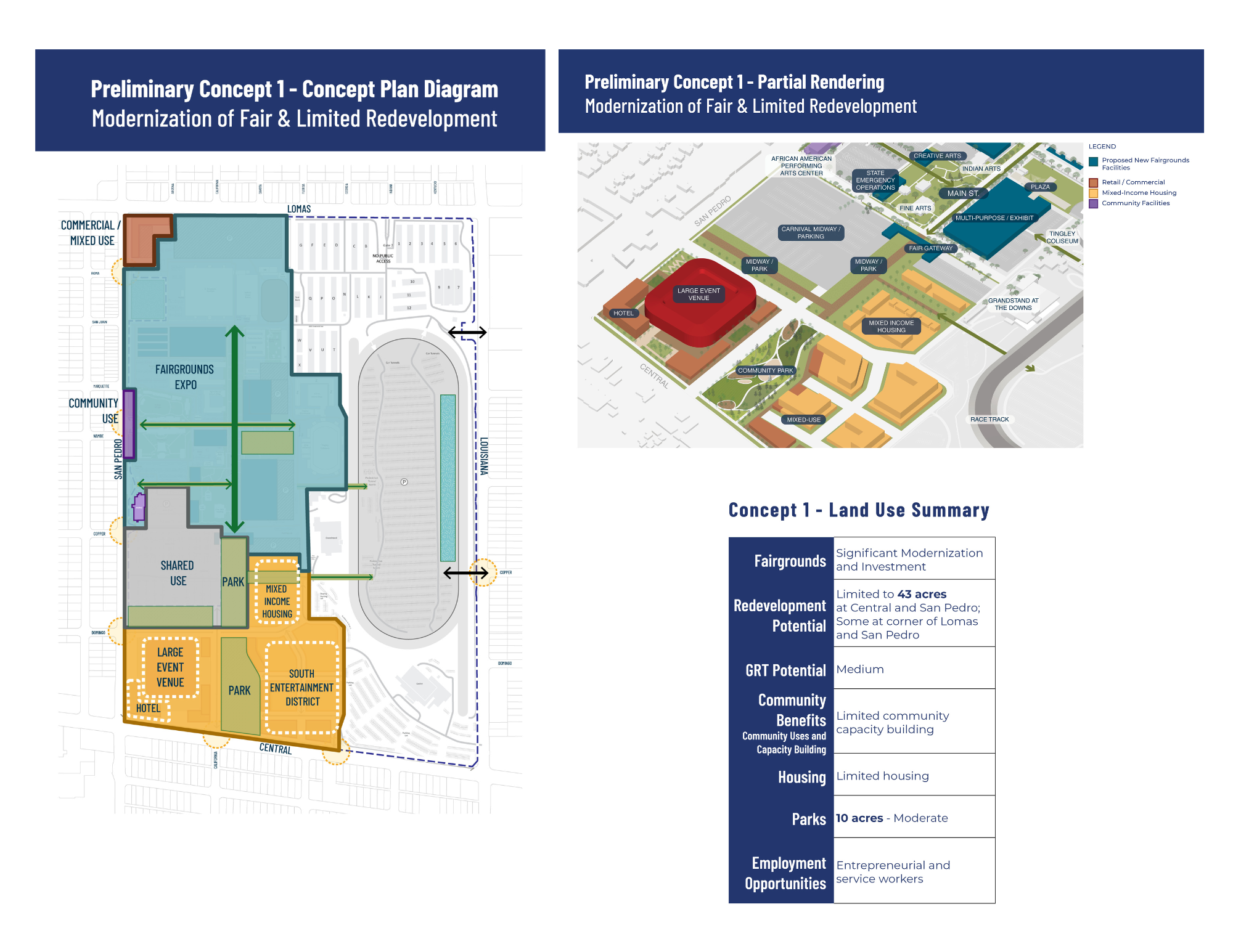
Concept One  maintains the midway, using it as a large parking lot for the rest of the year, but adds a new exhibition space, a 10-acre park, affordable housing, an event center and a hotel to the grounds’ south side.

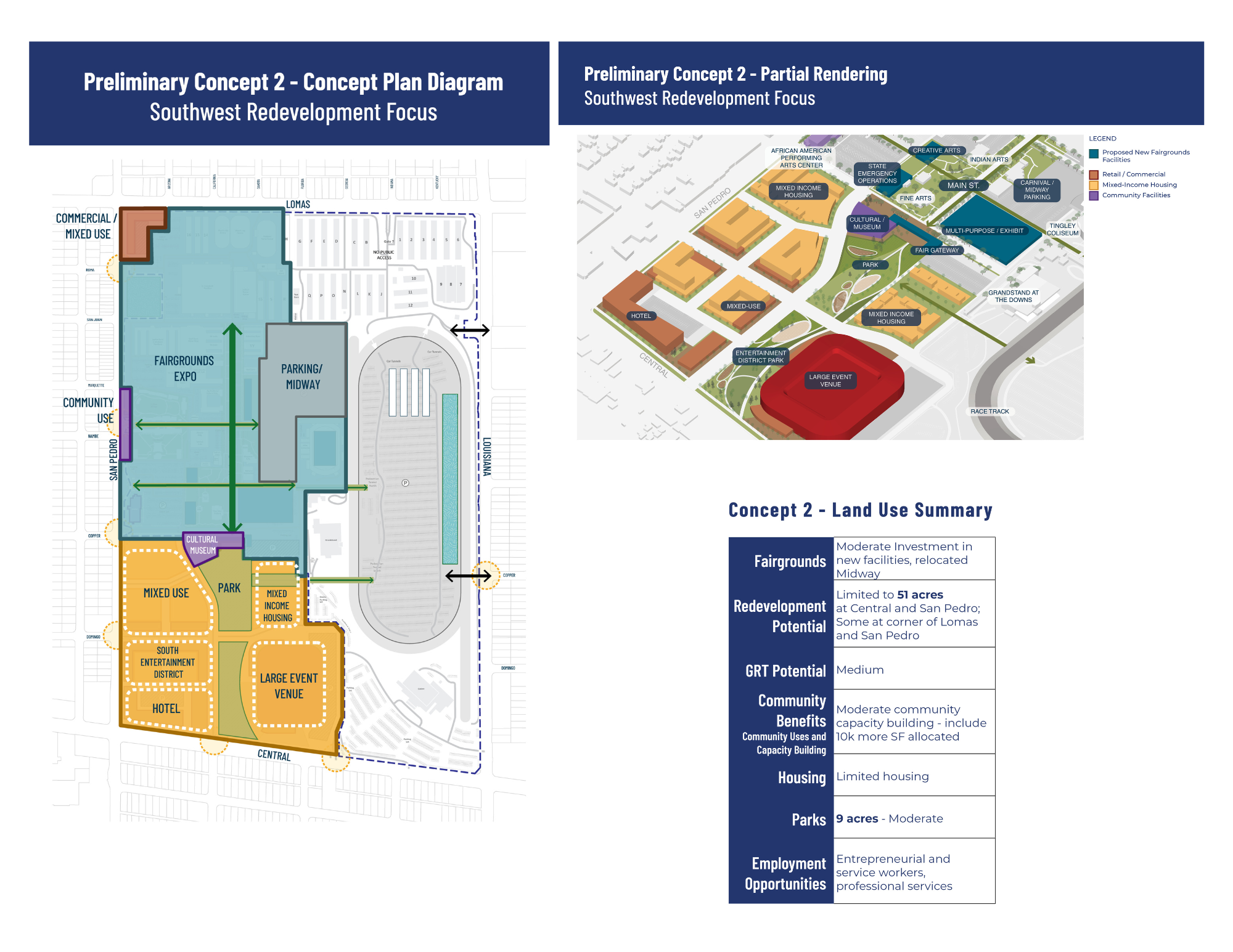
Concept Two significantly reduce the midway while new amenities like an  event center would take up more space. The second design also includes space for a museum.

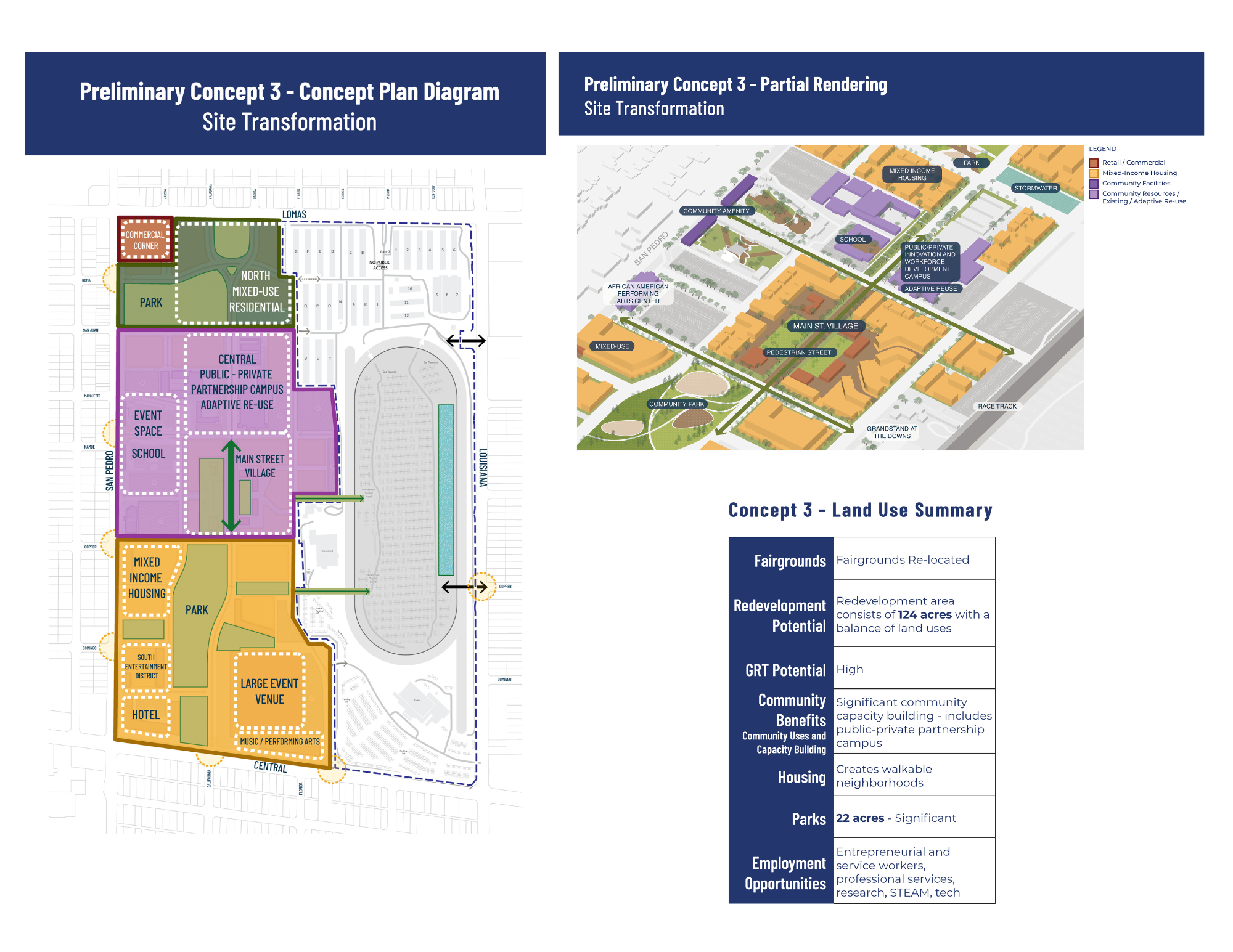
Concept Three is the most draconian of the three plans. It would require the fairgrounds to be completely relocated. On top of the amenities present in the previous designs, this design would include “hundreds” of housing units, a school, workforce development center and two parks that would add 20 acres for park areas.

Regardless of which of the three concept designs the state chooses, all three share some similarities, including a hotel, event venue, a new park, mixed-income housing and retail space. The tree-lined Main Street is preserved in all three designs.

All three of the concept plans place a major emphasis and dedicate large portions of the State Fair property to affordable housing and large park areas. The mixed used housing would include apartments, condominiums and town homes for low income or subsidized housing.

THREE CONCEPT PLANS SUMMARIZED

Concept Plan 1 maintains the State Fair on the Fairgrounds. It opens the space up to the community by creating 10 acre  public park, and creates an entertainment district with a large event venue and mixed housing. The redevelopment is limited to the 43 acres in the Southwest corner and has Gross Receipts Tax  (GRT) potential to support infrastructure and development. The space for housing is limited and there would be limited employment opportunities, mostly for service workers. Concept 1 preserves and enhances the existing Fairgrounds footprint, upgrading facilities while adding transformative new amenities. Those new amenities would include:

  • State-of-the-art multipurpose event venue
  • Mixed-use entertainment district
  • A modern exhibition hall

Click here for link to review the Concept 1 one plan.
Concept Plan 2  reimagines the State Fair and adjusts its footprint. It features a larger entertainment district complete with a venue and a hotel, as well as mixed use space, a slightly smaller 9 acre public park, and limited housing. The redevelopment potential is 51 total acres, including the Southwest corner off of San Pedro and Central that is now private property to be acquired, and some space on the corner of Lomas and San Pedro. This concept offers a moderate amount of community benefit potential and additional employment opportunities in entrepreneurial fields and professional services. Concept 2 relocates the State Fair Midway to make room for the development of “an expanded live-work-play neighborhood.” It proposes :

  • An arena complex
  • A mixed-use entertainment district
  • A multi-purpose exhibition hall for conferences and community events
  • A nine-acre public park

Click here for link to review Concept 2 .
Concept Plan 3  proposes the State Fair be relocated, completely transforming the site while maintaining the Fairgrounds Main Street. The Concept 3 plan has an expansive 22 acre public park, an entertainment district, education and workforce training space, and mixed housing. The redevelopment potential is 124 acres and offers a balance of land uses making the Gross Receipts Tax (GRT) potential high and the community benefits significant. The space for housing is large and designed as “walkable neighborhoods”. The employment potential include opportunities for entrepreneurs, service workers, professional services, research, STEM, and technology.  Concept 3 would completely overhaul the entire state fair area and build the following in the fairgrounds’ current footprint:

  • “Hundreds of homes”
  • “An innovation hub focused on next-generation technology”
  • A large event venue
  • “A walkable main street village”
  • “More than 20 acres of park and green space.”

Click here for link to review Concept 3 .
The link to the Fair Grounds “Reimagine” web site is here:

Home

GOV. MLG EMBRACES CONCEPT PLAN TO MOVE STATE FAIR

Immediately after the November 11 State Fair District Board meeting, Governor Lujan Grisham was interviewed by KRQE News 13.  The governor said she favors the third Concept Plan, which is the most aggressive concept plan that proposes moving the state fair. The Governor  said she is still waiting for cost estimates before making a final decision. The governor said this:

“I want a whole new footprint in the middle, the center of historic Albuquerque. I prefer option 3. …This state needs and deserves a robust state fair property.

Governor Lujan Grisham said she shares frustrations about crime in the area and criticized what she called a “lack of leadership and inadequate response from local officials and first responders.”  The Governor said this:

“When I look at the outcomes here, I am feeling very frustrated by the lack of progress. … I think this community should demand that we are all working together. … I think redevelopment has a real impact. … Prosperity makes opportunity.”

The Governor argued that redevelopment could help shift the neighborhood’s trajectory.

AREA RESIDENTS RAISE CONCERNS

The decision to redevelop the area, which Gov. Michelle Lujan Grisham announced over a year ago, has drawn both praise and down right hostility and anger from area residents.  The 236-acre tract of land in northeast Albuquerque has hosted the annual State Fair since 1938, but the state and its consultants say that the area is “underutilized” and its infrastructure is crumbling and that the State Fair Commission is saying the fair “has outgrown the property” justifying moving the fair to a new location.

The Governor’s Office called the redevelopment a “once-in-a-generation opportunity”.  Not everyone agrees with the Governor, especially those who live in the International District itself.  Many Area residents have argued in public planning meetings that the fairgrounds should stay for any number of reasons, ranging from concerns over crime to fears of gentrification.

While Stantec representatives emphasized the three Concept plans are still conceptual, the December 11 meeting drew a mixture  of optimism and skepticism from area residents who attended the meeting and who were interviewed by the media after the meeting. Audience members were not given an opportunity to address the board during the meeting.  Many areas residents who have attended past State Fair District  meeting and who have attended citizen input meetings with Stantec and responded to Stantec surveys have raised major concerns about crime, drug activity and homelessness in the International District surrounding the fairgrounds.

Albuquerque resident Wally Book told KOB 4 News this:

“We can dress up just this block, but until we address the surrounding area it’s not going to take hold.”

Another resident, Dave Kailer, questioned whether a proposed park could thrive in the area and said this:

“You know what is going to happen to that park if you put it in the war zone? It will turn into a homeless park, let’s face it. … I don’t want to be ugly about it or negative about it. I’m just being realistic.”

Pete Dinelli, who has lived directly North of the State Fairgrounds for over 40 years, told KRQE News 13 this:

“The State Fair District Board is attempting to use the State Fair property to solve all the crime and economic problems of the International District. Until you reduce crime and homeless on Central and in the International District itself, redevelopment of the State Fair property will fail.”

PUBLIC FEEDBACK AND FUTURE MEETINGS

The public can submit feedback on the designs online at fairgroundsdistrict.nm.gov or in-person at the final public input meeting planned for early January. Click here for a link to the survey.

The State Fair Board will continue gathering public input before selecting the preferred option. The board plans to meet in either January or February to go over each plan in more detail.  Any final plan would require approval from the State Board of Finance and the Legislature.

Links to relied upon or quoted news sources are here:

https://www.fairgroundsdistrict.nm.gov/

https://www.kob.com/new-mexico/state-leaders-review-plans-for-state-fairgrounds/

https://www.koat.com/article/preliminary-plans-unveiled-for-redevelopment-of-new-mexico-state-fairgrounds-expo-fair/69701845

https://www.krqe.com/news/albuquerque-metro/state-unveils-preliminary-plans-for-the-future-of-the-new-mexico-state-fairgrounds/

https://www.abqjournal.com/news/article_335683f7-894c-48bb-9451-dc4c761472fc.html

STRONG OPPOSITION TO MOVING STATE FAIR IGNORED BY GOVERNOR

Governor Lujan Grisham’s proposal to moving the state fair has been met with strong opposition and resentment from area residents of Albuquerque’s International District, which has dealt with rampant and rising drug use and homelessness in recent years. The proposed redevelopment has proven controversial with residents in the International District who say that they are concerned the funding will do little to help the neighborhood, will uproot the historic annual State Fair and will, like past efforts at fairgrounds redevelopment, be a flop.

On February 26, 2025,  Bernalillo County Government  held meeting to discuss and provide information on a proposed Tax Increment Development District (TIDD) for the New State Fairgrounds. Upwards of 200 residents attended. Most if not all of the public present for the February 26 meeting were very hostile to moving the state fair and spoke out against moving the state fair to another location.

Audience members were given the opportunity to speak after the presentation on the proposed Tax Increment District (TIDD). Audience members said that the City and the Mayor Keller Administration have been a total failure in cleaning up Central and the city has failed to address crime and the homeless crisis on Central. Audience members argued that before anything is spent on improving or moving the Fair Grounds, money would be better spent cleaning up Central, dealing with the homeless, drug addicted and mentally ill and providing them with services to get them off the streets.

COMMENTARY AND ANALYSIS

During the July 2 State Fair District meeting, Governor Lujan Grisham signaled  that she was backing off on moving the fairgrounds and said  that the State Fair might not have to find a new venue. Lujan Grisham said this in particular signaling a change is her stance:

“I want to be really clear about that, because you’ll notice I didn’t say a plan to move the State Fair.”

It’s downright laughable and pathetic that Governor Lujan Grisham has now embraced Concept 3 as her preferred plan. It is painfully obvious that Governor Lujan Grisham is simply ignoring the public opposition to moving the State Fair knowing that she is a lame duck with only a year left before her term ends to accomplish a legacy project she wants and to be rubber stamped by her appointed State Fair District Board and State Fair Commission. This coming from the Governor who went out of her way and  cautioned just a few months ago that no final decision had been made.

Concept Plan 3 is the most draconian of the 3 Concept Plans with the ultimate goal of  moving  the State Fair ground. Governor Lujan Grisham said she would like to see the project break ground before she leaves office at the end of next year. Her  words and action now confirm what she has said and what she has known all along and that is the Governor is hell bent on moving the state fair over strong public opposition and is rushing the project  to have a legacy project before she leaves office in a year.

A SHAM BOARD 

The biggest sham is that Governor’s appointed State Fair District Board and Stantec are going along with the Governors efforts to move the State Fair so that all of its property can  be dedicated to reviving and benefiting  the International District. The Governor and her board have essentially  ignored  the needs and concerns of neighborhoods and businesses to the West, North and East of the Fairgrounds.  Five out of the seven State Fair District Board members are elected officials of the International District with the President of the District 6 Coalition of Neighborhoods all in the International District.   

GOVERNOR BLAMES LOCAL LAW ENFORCEMENT AND LEADERSHIP

What is so very offensive is Governor Lujan Grisham blaming local law enforcement and local leadership for failing to deal with crime and  the unhoused crisis  in the International District. She then turns around in the same breath to argue that there is a need to “re dedicate”  the state fair property to solve those problems.  It is clear the State Fairgrounds redevelopment is being promoted by the Governor and her appointed State Fair District Board as being some sort of a great  panacea to solve the problems of crime, the homeless,  lack of  affordable housing  and lack of economic development in the International District. It will not.

The Fair Grounds cannot be characterized as the cause or as a magnet for crime within the International District. No statistics have been presented to the State Fair board on the extent of crime that occurs on the State Fairgrounds itself. No discussion has been held or proof offered as to what extent the State Fair grounds is responsible for crime in the International District.

The International District, which is bordered by Central South of the State Fairgrounds has had for decades some of the highest violent crime, property crime and drug offense rates, so much so that it was at one time referred to as the WAR ZONE until it was officially renamed the International District, but the renaming had no impact on the trajectory of the area.  The International District continues to be plagued by high crime rates and  now has become a magnet for the homeless with encampments constantly popping up and cleaned up by the city only to pop up again.

Crime and the unhoused is what is destroying  private investment, job growth and small business development within  in the International District. After all the millions are spent to redevelop the fairgrounds, to improve infra structure and traffic flow, building a park, adding public spaces and allowing businesses and low-income housing, the problems of high crime rates and the unhoused will remain the same in the International District because they have never been solved for decades. No businesses will want to relocate to the State Fair grounds after it is developed into commercial property, and it will become a magnet for crime and for the homeless, especially with parks.

AFFORABLE HOUSING

Efforts to address “affordable housing” continue to be a major target and goal for the State Fairgrounds District Board and is  a very big part of the presentations made to the State Fair District Governing Board by Stantec.  The three redevelopment Concept Plans for the property propose to commandeer a good portion of the Expo NM State Fair Property for affordable housing  and it is as absurd as it gets.

The term affordable housing is about as misleading as it gets. It is a term often used by politicians, elected officials and developers to promote their own personal or political agendas. Simply put construction costs are consistent when it comes to housing and in today’s market are extremely high as are existing housing costs.  When the term “affordable housing” is used by the politicians, elected officials and developer’s, what is meant is “subsidized government housing”. 

Affordable housing or subsidized housing for low-income income earners is not the highest and best use of any portion of the 236 acres of prime property for development in the center of Albuquerque. It would put a small dent in the shortage of housing.

The highest and best use of the 236 acres of property is the State Fair itself and keeping it as Expo New Mexico and developing a year-round Entertainment District and to preserve the New Mexico State Fair and Expo New Mexico where it is now.

Efforts for affordable housing use for the State Fair grounds should be abandoned in that it would impair the overall goal and development of the property for projects that benefit the entire community as a whole and for public use.

PARKS WILL BECOME MAGNETS FOR CRIME AND THE  HOMELESS

All three of the concept plans place a major emphasis and dedicate large portions of the State Fair property to park areas with access from Central or San Pedro to the parks. Concept One provides a 10-acre  public park. Concept Two provides a 9-acre public park. Concept three provides for a 22-acre  public park.

The reality of the city’s homeless crisis is that parks are notoriously magnets for crime and the unhoused. At this point, the State Fairgrounds, does not have a crime problem with the New Mexico State Police having primary law enforcement responsibility to calls for service. The lack of crime on the state fair property will no doubt change with parks.

Area resident Dave Kailer was absolutely correct when he was  questioned whether a proposed park could thrive in the area and he said this:

“You know what is going to happen to that park if you put it in the war zone? It will turn into a homeless park, let’s face it. … I don’t want to be ugly about it or negative about it. I’m just being realistic.”

History tends to repeat itself over and over again especially when it comes to the homeless crisis. Governor Mitchell Lujan Grisham might as well dedicate any park on State Fair grounds property with public access as Coronado Park 2 in remembrance to Coronado Park which was closed by the city as a result of more than 125 unsheltered people taking over the park to camp and it becoming a hot bed for narcotic usage, trafficking illicit drugs and violent crime, including homicides and rapes. Coronado Park became a “de facto” city sanctioned homeless encampment thanks to Mayor Keller’s reluctance to do do anything about the unauthorized use of the park by the homeless and costing the city $50,000 to clean it up each month. Eventually, Keller declared Coronado Park as the most dangerous place in the state to be and ordered the park closed.

FINAL COMMENTARY

The Governor and her appointed State Fair District Board is attempting to use the State Fair property to solve all the crime, economic problems and lack of affordable housing of the International District.  Until you reduce crime and homeless on Central itself and in the International District itself, redevelopment of the State Fair property as envisioned by the Governor and Stantec will fail and Governor Lujan Grisham will go down as the Governor who destroyed the State Fair for the sake of her ego.

Governor Michelle Lujan Grisham, Albuquerque Mayor Tim Keller, Senate Pro Tempore Mimi Stewart, State Representative Janelle Anyanonu, City Councilor Nichole Rogers and County Commissioner Adriann Barboa who are the elected officials and politicians on the “State Fairgrounds District Board” need to keep their greedy little hands off the State Fair grounds and abandon any effort to move it or dedicate it for affordable housing and parks. Simply put, the surrounding neighborhoods, businesses and their constituents want the State Fair to remain where it is. They need to listen for a change and knock it off pretending to be developers.

The links to  related articles are here:

NM State Fair District Board OKs $67M In Infrastructure; “Pre-Development Concepts” Envision 10 Acre Park And Affordable Housing; COMMENTARY: Governor MLG And Board Falsely Believe Fair Grounds Redevelopment Panacea To Solve International Districts Crime And Housing Problems; Dedicated Park Will Be Magnet For Crime And Attract Homeless Encampments

Stantec Consulting Services Inc. Holds First Of Three Public Meetings On Redevelopment Plans For State Fair Grounds; State Fairgrounds District Board Approves $22.5 Million For Property Acquisition; Expo New Mexico With No Affordable Housing Highest And Best Use For State Fair Grounds Property

“State Fairgrounds District Board” Holds First Meeting; Gov. MLG Merely Suggests State Fair May Not Be Moved Contrary To Her Expressed Thoughts; Development Of Master Plans Moves Forward; Highest And Best Use Of Property Is “Expo New Mexico” And Creation Of Year Around Entertainment District With No Affordable Housing   

ABQ Journal Dinelli Local Columnist Opinion Column: “Keller Should Adopt New Strategy In Third Term”; Keller Should Make It Clear Not Running For 4thTerm

The Albuquerque Journal Editorial Opinion pages feature 5 types of opinion columns submitted for publication: those by the paper’s Editorial Board, those by the paper’s Community Council, those by Syndicated Columnists, those by Local Columnists and those by Local Voices.

Local Columnists are tasked with carrying a heavy load of responsibility to help readers scrutinize issues impacting them, their community and their country. It is the Journal’s goal to publish columnists from all walks of life and varying political viewpoints to give readers exposure to all sides of local issues.”

All headlines for Albuquerque Journal guest opinion columns published are written by Journal editors and not the columnists.

On December 11, the  Albuquerque Journal published on its editorial opinion page A8 the below “Local Columnist” opinion column by Pete Dinelli:

JOURNAL EDITOR’S HEADLINE:  Keller Should Adopt New Strategy In Third Term

BY PETE DINELLI, LOCAL COLUMNIST

Congratulations to Mayor Tim Keller for his 58% To 42% victory over Darren White as Keller becomes the first mayor elected to a third consecutive four-year term.

Voters saw the most contentious runoff in the city’s history. Keller and White vilified each other pointing out each other’s numerous flaws. It was a runoff between two of the most disliked candidates to ever run for mayor.

Keller is the progressive Democratic mayor who has failed to successfully prohibit the homeless from proliferating city streets and parks despite spending millions on shelters and programs. Keller failed to bring down high crime rates over eight years while the Albuquerque Police Department was involved in a DWI dismissal scandal.

Republican White is the former elected official with two decades of disgraceful public service. Like Donald Trump, White sought to divide voters by threatening undocumented immigrants with Immigration and Customs Enforcement arrests and immediate removal of homeless encampments.

Keller clawed his way back from a low approval rating of 42% to win a hard-fought election. Keller running against a very weak slate of candidates and qualifying for $1.14 Million in public finance helped.

It’s not very often that elected officials who have very low approval ratings are given a third consecutive chance to succeed. KELLER’S THIRD TERM IS NOT AT ALL LIKELY TO BE ANY BETTER THAN THE PAST EIGHT YEARS, UNLESS HE RECOGNIZES THAT PEOPLE DID NOT VOTE FOR HIM AS MUCH AS THEY VOTED AGAINST HIS MAGA REPUBLICAN OPPONENT WHITE.

To succeed in a third term, Keller should say without doubt he will not seek a fourth term, knock off his publicity-seeking ways and just govern. Keller needs to acknowledge what he has done for eight years has not worked and must change course to succeed.

The three main areas Keller should concentrate on are: a totally different approach to get the homeless off the streets, APD reorganization and proactive policing practices, and abandonment of divisive efforts to change the city’s zoning laws to benefit developers at the expense of neighborhoods and property rights.

The unhoused crisis has only gotten worse under Keller as he allows the homeless free reign of the city. According to the 2025 Point In Time tabulation, 50% are not even from New Mexico. The city has built a Gateway network under Keller that includes emergency shelters but many homeless people refuse to use it. A major new initiative should be made on civil mental health commitments for the mentally ill and the drug addicted to get them off the streets.

APD is a train wreck, top heavy with mid-management and plagued by a DWI dismissal scandal. Keller needs to appoint a new chief and replace the entire command staff and completely reorganize the department for a new generation of leadership. APD cannot deal with the city’s high crime rates because APD’s sworn personnel is at 925.

Keller embellishes the city’s affordable housing shortage, declaring it a government crisis. To solve the crisis, Keller wants to  increase the city’s density in established neighborhoods and allow residential property owners to “upzone” their properties.  Keller’s policies will destroy established neighborhoods and will lead to gentrification as Keller angers many with his zoning changes that favor developers. Keller must find a better way to increase affordable housing.

Best wishes to Mayor Keller on his third term.

Pete Dinelli is a former Albuquerque city councilor, former chief public safety officer and former chief deputy district attorney. You can read his daily news and commentary blog at www.PeteDinelli.com.

The link to read the Albuquerque Journal Dinelli column with photos is here:

https://www.abqjournal.com/opinion/opinion-keller-should-adopt-new-strategy-in-third-term/2937659

The link to a related article is here:

Mayor Tim Keller Wins Historic Third Term Securing 57.71% To Darren White’s 42.29% Of The Vote; Stephanie Telles Wins District 1 City Council Over Joshua Neal, 59.46% To 40.55 %;  Klarissa Peña Wins District 3 City Council By 1.03% Over Teresa Garcia, 50.52% to 49.49%; Progressive Democrats Fail To Take Over Council Majority

Examining The Record Of Mayor Tim Keller And Darren White’s Record Of Failure And Divisive Campaign For Mayor; Vote To Re-Elect Tim Keller Mayor

Mayor Tim Keller Wins Historic Third Term Securing 57.71% To Darren White’s 42.29% Of The Vote; Stephanie Telles Wins District 1 City Council Over Joshua Neal, 59.46% To 40.55 %;  Klarissa Peña Wins District 3 City Council By 1.03% Over Teresa Garcia, 50.52% to 49.49%; Progressive Democrats Fail To Take Over Council Majority

On December 9 at approximately 7:53 pm., less than one hour after polls closed, Mayor Tim Keller was declared the victor over Darren White by the media. The final vote was not even close with Keller winning by 15%. The final vote was:

  • Tim Keller                74,421       57.71%
  • Darren White           54,538       42.29%

The link to the final vote tabulation is here:

https://results.bernco.gov/

Mayor Tim Keller campaigned on his eight-year record of fighting crime and expanding housing for the 5,000 or more unhoused people in the city. That included opening a multifaceted Gateway system of care and creating the city Community Safety Department to respond to behavioral health and crisis situations in the city.

Darren White campaigned on his law enforcement background, saying 8 years of Keller was enough and that it was time for a change. He promised a change of direction, emphasizing aggressive encampment sweeps of homeless individuals, and full cooperation with federal immigration agents seeking access to data on suspects arrested by APD. He said he entered the race after lamenting about the “state” of the city, and finding no other Republican was running. White promised he would only serve for four years.

Mayor Keller spoke to his supporters at The Clyde Hotel downtown and said this in part about his win and the city’s future:

 “Voters granted us something very, very special. …  The city has spoken, and folks have essentially said one thing loud and clear: they want us to keep going.  … We are not going to allow ICE in. We are not going to let Trump come into Albuquerque. … It’s a mandate to push forward, and it’s also a challenge to rise to the occasion. That’s what our next four years are going to be all about. … I see what you see. I understand what’s going on in the streets. … These are truly challenging times. But also challenging times politically. Look this was a campaign. We know we were attacked from all sides.”

Darren White conceded the mayoral race around 7:45 p.m., 45 minutes after the polls closed, to a crowd of about  60 people gathered at the Courtyard by Marriott, across the city from downtown, at a hotel in the Journal Center. Darren White gave his concession speech and said this in part:

“Yes, we are disappointed by the results. But we respect their choice. We came up short, but our call for change and a better quality of life should resonate long and wide. … Don’t you think for a minute that your voice can’t be heard. And don’t think for a minute that you should give up and say the hell with this. Because this is our city, and we love it, and that’s what we were fighting for. … And maybe just maybe, what we went through in those debates and those forums, maybe just maybe, the mayor will understand that we want him to fight for our families, and we want him to fight for our businesses.”

CITY COUNCIL SEATS

West Side voters also decided on the two westside Albuquerque City Council races in Districts 1 and 3.

In City Council  District 1, Progressive Democrat Stephanie Telles prevailed over MAGA Republican Joshua Taylor Neal in the runoff for the open West Side council district seat to succeed City Councilor Louie Sanchez, who chose not to seek a second term to pursue an unsuccessful bid for mayor coming in fourth. Democrat City Councilor Sanchez endorsed Republican Neal. The final vote was:

  • Stephanie Telles       9,071        59.46%
  • Joshua Neal              6,186        40.55%

In City Council District 3, three term incumbent moderate Democrat Councilor Klarissa Peña prevail over her  challenger Progressive Democrat Teresa Garcia with the closest margin as it gets winning by a mere 69 votes or 1.03%.The final vote was:

  • Klarissa Peña         3,338           50.52%
  • Teresa Garcia         3,270           49.49%

The link to the final vote tabulation is here:

https://results.bernco.gov/

The links to quoted or relied news sources are here:

https://www.kob.com/new-mexico/keller-wins-albuquerque-mayoral-election/?cb=1765336814365

https://www.koat.com/article/tim-keller-wins-albuquerque-mayor-election/69680229

https://www.krqe.com/news/politics-government/elections/tim-keller-wins-3rd-term-as-albuquerque-mayor/

https://www.abqjournal.com/news/article_31f89c61-9332-482e-9c9a-d1b14190bbd5.html

COMMENTARY AND ANALYSIS

There are no term limits for Albuquerque mayor. With his victory, Mayor Tim Keller secured a historic third consecutive four year term as Albuquerque Mayor. No previous Albuquerque mayor has served for three consecutive terms. Mayor Martin Chavez served for three terms but they were not consecutive. Chavez served one term from 1993-1997 then  left the Mayor’s office to run unsuccessfully for Governor. Chavez lost to Republican Governor Gary Johnson and returned to run for mayor again and won twice and served two consecutive terms from 2001-2009.

Voters saw the most contentious runoff in the city’s history with Mayor Tim Keller securing what many would call a landslide victory over Darren White after a contentious campaign by both candidates as they battled over the topics of high crime rates and the homeless.

Keller and White vilified each other pointing out each other’s numerous flaws. The politcal reality was we had a runoff between two of the most disliked candidates to ever run for Mayor. Mayor Keller clawed his way back from a low approval rating of 42% to win a hard-fought election.

Mayor Keller was the only candidate for  Mayor of seven candidates whose campaign was publicly financed. Keller was given more than $1.14 million in contributions for both the regular local and runoff elections, compared to White’s reported total of $642,429 in private contributions. White didn’t qualify for the public financing.

Tim Keller running against a very weak slate of 6 candidates and being the only one to qualify for $1.14 Million in public finance were likely the deciding factors for his win along with Keller’s built in advantage of incumbency and his very loyal progressive democratic party base.

NEW CITY COUNCIL

When it comes to the new city council, it will now be evenly split with 4 very progressive Democratic City Councilors, 4 MAGA Republican City Councilors and one moderate Democrat City Council who will likely be the swing vote on major issues. In other words, the politcal dynamics will be the same as before but with the identity of the swing vote changing. It was first term District 1 Conservative Democrat Louie Sanchez who more often than not sided with the 4 MAGA Republicans on the City Council to thwart the efforts of the Progressive Democrat City Councilors. Sanchez did not seek reelection and ran unsuccessfully for Mayor and came in fourth out of seven total candidates running.

The City’s progressive Democratic leaning organizations and Democratic Progressive party members made a very strong bid to give the City Council a decidedly progressive lean, but the effort fell short. Incumbent moderate Democrat City Councilor Klarissa Peña won by a mere 69 votes or 1.03% over progressive Democrat Teresa Garcia for the City Council District 3 seat representing the SW Mesa area.

The Peña/Garcia city council race attracted leading progressives to get involved with the race. Mayor Tim Keller endorsed Peña as did Democratic Congresswoman Melanie Stansbury and Democratic Governor candidate Deb Haaland. Democratic Senior Senator Martin Heinrich and State Senator Katy Duhigg endorsed Democrat Teresa Garcia.

It will Incumbent moderate Democrat City Councilor Klarissa Peña who assume the critical role as swing vote replacing Conservative Democrat Louie Sanchez who often sided with the four MAGA Republicans. With the departure of Conservative Democrat City Councilor Louie Sanchez and his replacement by Progressive Democrat Stephanie Telles, Mayor Keller should have improved relations with the City Council, but not that much more.

The breakdown of the new City Council is as follows:

PROGRESSIVE DEMOCRATS

  • District 1 Progressive Democrat City Councilor Stephanie Telles
  • District 2 Progressive Democrat City Councilor Joaquín Baca
  • District 6 Progressive Democrat City Councilor Nichole L. Rogers
  • District 7 Progressive Democrat City Councilor Tammy Fiebelkorn

MAGA REPUBLICANS

  • District 4 Republican City Councilor Brook Bassan
  • District 5 Republican City Councilor Dan Lewis
  • District 8 Republican City Councilor Dan Champine.
  • District 9 Republican City Councilor Renée Grout

SWING VOTE

District 3 Moderate Democrat City Councilor Klarissa Peña.

NEW CITY COUNCIL PRESIDENT AND VICE PRESIDENT FIRST ORDER OF BUSINESS

The first item of business the new city council will vote upon in its first meeting after being sworn in will be the election by the 9 city councilors of President and Vice President. The City Council President has the authority to appoint all city council committee chairmanships and for that reason sets the tone for how business is conducted and what is accomplished.

There is already rumors circulating that District 2 Progressive Democrat  City Councilor Joaquín Baca wants to be the new City Council President. However, the real question is if District 3 Moderate Democrat City Councilor Klarissa Peña wants the job, which she has done before, and if the 4 MAGA Republicans will support her as President as a reasonable compromise.

CONCLUSION

Congratulations to all the victors  and best wishes as they carry out the business of the people.

Early Voting Strong For December 9 Runoff Election; In Addition To Mayor, Two City Council Seats To Be Decided; Please Vote!

According to the Bernalillo County Clerk’s Office,  23% or upwards of 83,000, of eligible Albuquerque voters have already voted early or have cast absentee ballots as of midday Monday December 8 for the December 9 runoff municipal election. On the ballot city wide is the Mayors race between incumbent Progressive Democrat Mayor Tim Keller and MAGA Republican Darren White.  West Side voters also will decide two Albuquerque City Council races in Districts 1 and 3 when they go to the polls on December 9.

The 83,000 early voting  number exceeds the nearly 75,500 early voting and absentee votes cast in advance of the Nov. 4 election. This year in the November 4 election, nearly 135,000 votes or 37.1% of registered city voters were cast where seven candidates for Mayor were on the ballot. That surpassed the 32% turnout mark from the city’s last mayoral election in 2021.  Albuquerque’s last mayoral runoff election in 2017 brought out 28.7% of eligible city voters. That year, a total of 96,864 votes were cast in a runoff between Keller and City Councilor Dan Lewis. Mayor  Keller won his first term as mayor by a landslide with 62% of the vote to Lewis’ 38%.

City Desk, the on line news publication, reported by the time early voting ended Saturday December 6, a total of  82,013 votes had been cast or 22% of eligible voters had voted in the runoff. Of those, 43,350 or 53% were registered Democrats and 26,131 or 32% were registered Republicans. Another 12,529 or 15% are “decline to state” or independent. The early vote in all likely gave Mayor Keller the advantage. However, Republicans are known for voting in greater numbers on Election Day and City Desk ABQ reported  White was tracking a “large number” of anti-Keller Democrats saying they voted for White.  Keller’s campaign for its part has told supporters the race is closer than partisan registration would predict. As a result, the Keller campaign relied heavily over the weekend before election day on “door to door” efforts to  get out to vote  to boost election day turn out, especially amongst Democrats.

The strong early voting turnout is definitive evidence that there is strong interest in the outcome of the Mayor’s race between Mayor Tim Keller, who is seeking and unprecedented third term, and Republican and former two term Bernalillo County Sherriff Darren White. In the November  4 regular election, Keller received 36% of votes cast compared with 31% for White in a seven-way contest. The race between the two has proven to be one of the most contested and negative campaigns for Mayor in the city’s history.

Brian Sanderoff, president of Albuquerque-based Research & Polling Inc., who does the exclusive polling for the Albuquerque Journal, said that what has  driven the increase turnout is a choice between two experienced and well-known candidates who hold markedly different positions on a variety of issues. Sanderoff said the decision for voters comes down to whether they want to give Tim Keller another term or opt for change, and if that change is with Darren White. The mayoral race has been hard-hitting, focusing on crime and homelessness. Sanderoff said this:

“We’ve had a robust turnout for early and absentee voting. … We should have total votes cast similar to the Nov. 4 election. … The fact that they’re well known and the fact that they’re so different from each other contributes to the high turnout. These are [two] people who really come from different perspectives, different styles, different policy positions. And so the voters have a real choice here. …  We’re hearing two different viewpoints. Same thing with homelessness. You know, Darren White says on day one he’s going to clean up the encampments. Tim Keller saying, you can’t arrest your way out of this issue. So, the voters have some pretty good choices here, pretty distinct choices.” 

CITY COUNCIL SEATS

West Side voters also will decide the two westside Albuquerque City Council races in Districts 1 and 3. The races  are:

In City Council  District 1, Progressive Democrat Stephanie Telles faces off against Republican Joshua Taylor Neal for the open West Side council district seat. On November 4, Telles received 36% of the vote to Neal’s 26% in a four-way contest to succeed Councilor Louie Sanchez, who chose not to seek a second term to pursue an unsuccessful bid for mayor.

In City Council District 3, three term incumbent moderate Democrat Councilor Klarissa Peña faces off against challenger Progressive Democrat Teresa Garcia. Peña received 41% of the vote to Garcia’s 38% share in a three-way contest. District 3 is located in far southwest Albuquerque.

The link to a relied upon or quoted news sources is here:

https://www.abqjournal.com/election/article_12e313b7-294a-4493-a27d-fa3331f83404.html

https://www.koat.com/article/albuquerque-voters-decide-mayoral-and-city-council-runoff-elections/69671385

https://www.koat.com/article/what-is-a-runoff-election-albuquerque-2025/69257433

https://www.krqe.com/news/politics-government/elections/albuquerque-runoff-election-2025-key-information-and-races-to-know/

COMMENTARY

The 50 voting sites open from 7 a.m. to 7 p.m

Please vote December 9 if you have not already voted!

The link to a related article is here:

Examining The Record Of Mayor Tim Keller And Darren White’s Record Of Failure And Divisive Campaign For Mayor; Vote To Re-Elect Tim Keller Mayor

2025 Point In Time Count Of Unhoused Finds 8% Increase In City; Goes From 2,740 In 2024 To 2,960 In 2025;  50% Of Unhoused Found Not To Be From New Mexico; City Spends Millions On Shelters And Services The Unhoused Reject; Civil Mental Health Commitment Hearings Viable Option To Get Unhoused Off Streets

On November 17, the New Mexico Coalition to End Homelessness released the 2025 Point-In-Time (PIT) Report for the numbers of unhoused in Albuquerque. This year’s PIT count occurred on the night of Wednesday January 22, 2025. The link to review the entire 62-page 2024 PIT report is here:

https://568ac5c8-a616-4ffa-987e-7f77d5d1e6aa.filesusr.com/ugd/ad7ad8_0b3a57c7ce914d7f9bc94b6ea37be15c.pdf

2025 PIT REPORT IN A NUTSHELL

The highlights of the 2025 Point-In-Time (PIT) Report data can be summarized in a nutshell as follows:

The report showed 29,735 people were engaged with “any part of New Mexico’s homeless response system in 2024.”

New Mexico Public Education Department data showed 10,533 students identified as experiencing homelessness during the 2024-25 school year.

Men  are more prevalent than women in emergency shelters and in unsheltered situations.

The report also had the following statistics:

2,960 total homeless people were reported in Albuquerque, which broken down is as follows:

  • 1,367 are reported as unsheltered people
  • 1,327 are reported in emergency shelters which is up from 658 in 2011
  • 266 in transitional housing with women more prevalent than men in this type of housing
  • 8% of people reported experiencing homelessness for first time
  • 2,566 total are reported as homeless groups/families in Albuquerque

1,723 total homeless people throughout the rest of New Mexico is broken down as follows:

  • 779 unsheltered people
  • 774 in emergency shelters
  • 170 in transitional housing
  • 39% of people reported experiencing homelessness for first time

There are 1,417 total homeless groups/families throughout the rest of New Mexico

The Percentage of women citing domestic violence in Albuquerque:  30.3%

The Percentage of women citing domestic violence throughout the rest of New Mexico: 36.2%

The Percentage of unsheltered people with military service in Albuquerque:  8.61%

The Percentage of unsheltered people with military service throughout the rest of New Mexico: 8.55%

2025 PIT REPORT NARRATIVE SUMMMARY

According to the 2025 Point-In-Time (PIT) survey at least 2,960 people in Albuquerque called the streets or an emergency shelter their home with nowhere else to go.  Of that number, 1,367 people were completely unsheltered with no roof over their heads, living on the streets or in emergency shelters with nowhere else to go. The 2025 PIT report revealed an 8% increase in homelessness going from 2,740 in 2024 to 2,960 in 2025, an increase of 220 people.

The 2025 PIT survey reports the number of homeless individuals in Albuquerque has consistently increased since 2013, with the exception of 2022, when a harsh winter and fewer surveyors likely lowered the number.

Survey respondents answered questions about their experience with homelessness. Most commonly, homeless people said their biggest barrier to housing was missing documentation, at 55%. The survey did not specify what documents were missing or why they had been missing. However, officials with the New Mexico Coalition to End Homelessness did say roughly 80% of respondents in 2024 said they had lost a birth certificate, Social Security card or driver’s license during city  encampment sweeps.

Lack of housing vouchers and high rental prices followed as the second-biggest reasons, with 43% of respondents citing those as their reasons for homelessness.

The 2025 PIT report states this:

“While the rise is concerning, it reflects what service providers have been seeing for months: growing housing instability, limited affordable options, increase of cost of living and community systems [are] stretched beyond capacity. ”

DEMOGRAPHICS BREKDOWN

Certain demographics were overrepresented  in the reported data.

INDIGENOUS  PEOPLE

Despite making up about 9% of New Mexico’s population, 17% of the unsheltered population were Indigenous  people.

American Indian or Alaska Native and Black or African American individuals are “overrepresented in the homeless population compared to the state population.”

Diné – Navajo is the largest tribal group among the unsheltered in both Albuquerque (49.1%) and throughout New Mexico (49.5%).

AGE

People ages 35-44 were the highest number of unsheltered people, with 479 people staying in the streets the night of January 22. The same age group was also the highest in terms of seeking emergency shelter.

The study showed a massive increase in seniors experiencing homelessness since 2023, with a 23.6% increase. People ages 55-64 had a 43% increase in homelessness since 2023.

William Bowen, a Continuum of Care (CoC) program officer for the New Mexico Coalition to End Homelessness, said the boost in seniors experiencing homelessness might show a change in older people being unable to work. However, seniors also sought out emergency housing at a higher rate than other age groups. They made up 34% of people in shelters.

FIRST TIME HOMELESS FROM OUT OF STATE

The report showed of the 1,367 unsheltered people, 49.8% of them said they were experiencing homelessness for the first time, a “sharp uptick” that may be linked to things such as  inflation and repeals of pandemic-era relief programs, including an eviction moratorium.

The 2025 PIT study found nearly 50% of respondents were not from New Mexico.  A majority of transplants said they were from Texas, Arizona or Colorado. About 36% of those respondents said they were not homeless prior to moving to New Mexico.  William Bowen, a Continuum of Care (CoC) program officer for the New Mexico Coalition to End Homelessness said this:

“It is more common for people to become homeless after relocating.”

DATA DOWNLOAD OF 2025  PIT COUNT

The 2025 PIT Count found 2,960 total people within 2,566 total households experienced homelessness in Albuquerque on January 22nd, 2025 with  a total 1,723 in the balance of the state.

People in households with at least one child were found in Emergency Shelters at a higher rate at 73.8% than Transitional Housing at 21.8% or Unsheltered Homelessness at 4.4%.

By comparison, of the 1,723 total people within 1,417 households facing homelessness in the Balance of State Continuum of Care (CoC)  organizations  with at least one child were found in Emergency Shelters at a rate of 66.2% as compared to 27.6% in Transitional Housing and 6.2% as Unsheltered Homelessness.

Following are the breakdowns for both Albuquerque and the Balance of the State breakdowns:

ALBUQUERQUE PIT COUNT BY HOUSING TYPE 2025

  1. PERSONS IN HOUSEHOLDS WITH AT LEAST ONE CHILD:
  • Emergency Shelters:     304
  • Transitional Housing:      90
  • Unsheltered:                   18

Total:    412

  1. PERSONS IN HOUSEHOLDS WITH ONLY CHILDREN
  • Emergency Shelters:         5
  • Transitional Housing:       10
  • Unsheltered:                      1

 Total: 16

  1. PERSONS IN HOUSEHOLDS WITHOUT CHILDREN
  • Emergency Shelters:    1,018
  • Transitional Housing:       166
  • Unsheltered:                 1,348

 Total: 2,532

    4.   Total Persons:

  • Emergency Shelters:       1,327
  • Transitional Housing:         266
  • Unsheltered:                    1,367

Total:   2,960

BALANCE OF THE STATE  PIT COUNT BY HOUSING TYPE 2025

  1. PERSONS IN HOUSEHOLDS WITH AT LEAST ONE CHILD:
  • Emergency Shelters:       245
  • Transitional Housing:       102
  • Unsheltered:                      23

Total:  370

  1. PERSONS IN HOUSEHOLDS WITH ONLY CHILDREN
  • Emergency Shelters:      33
  • Transitional Housing:       4
  • Unsheltered:                    2

 Total:  39 

  1. PERSONS IN HOUSEHOLDS WITHOUT CHILDREN
  • Emergency Shelters:      496
  • Transitional Housing:       64
  • Unsheltered:                   754

Total: 1,314

  1. Total Persons:
  • Emergency Shelters:          774
  • Transitional Housing:          170
  • Unsheltered:                       779

TOTAL:    1,723

2025 Point-In-Time (PIT) Report, page 11.

ALBUQUERQUE 2025  PIT COUNT BY GENDER

Woman (or girl)  (Numbers and % of Total)

  • Unsheltered:                     527      (36.9%)
  • Transitional Housing:       131       (49.3%)
  • Emergency Shelter:         454       (34.2%)

Man (or boy) (Numbers and % of Total)

  • Unsheltered:                     871      (60.9%)
  • Transitional Housing:        131      (49.3%)
  • Emergency Shelter:           868      (65.5%)

Transgender,  Non-Binary,  More Than One Combined Totals

  • Unsheltered:                   11
  • Transitional Housing:        4
  • Emergency Shelter:          5

TOTALS: 

  • Unsheltered:                   711 
  • Transitional Housing:     266
  • Emergency Shelter:      1,327

       Total:  2,304

2025 Point-In-Time (PIT) Report, page 17

ALBUQUERQUE PIT COUNT BY RACE (Numbers and % of Total)

Hispanic/Latina/e/o (only)

  • Un-sheltered Count      562    (41.1%)
  • Transitional Housing       97    (36.5%)
  • Emergency Shelter       444    (29.8%)

White

  • Un-sheltered Count       318    (23.3%)
  • Transitional Housing      87     (32.7%)
  • Emergency Shelter       447    (30.0%)

American Indian or Alaska Native

  • Un-sheltered Count     268    (19.60%)
  • Transitional Housing    39     (14.7% )
  • Emergency Shelter     182     (12.2%)

Black or African American

  • Un-sheltered Count     93      (6.8%)
  • Transitional Housing   15       (5.6%)
  • Emergency Shelter    132      (8.9%)

Asian or Asian American

  • Un-sheltered Count       5    (0.4%)
  • Transitional Housing      2    (0.8%)
  • Emergency Shelter      12   (0.8%)

Native Hawaiian or Other Pacific Islander

  • Un-sheltered Count     12     (0.9%)
  • Transitional Housing      1     (0.4%)
  • Emergency Shelter       27     (1.8%)

Multiple Races

  • Un-sheltered Count      109     (8.0%)
  • Transitional Housing      25      (9.4%)
  • Emergency Shelter      241     (16.2%)

TOTALS:

  • Un-sheltered Count      1,367   (100% ) 
  • Transitional Housing      266   (100%)    
  • Emergency Shelter       1,488   (100%)

 2025 Point-In-Time (PIT) Report, page 18

ALBUQUERQUE’S 2009 TO 2025 STATISTICS

Total number of PEOPLE counted during the Albuquerque Point-in-Time counts from 2009 to 2025 to establish a graphic trend line for the period are as follows:

  • 2009: 2,002
  • 2011: 1,639
  • 2013: 1,171
  • 2015: 1,287
  • 2017: 1,318
  • 2019: 1,524
  • 2021: 1,567
  • 2022: 1,311
  • 2023: 2,394
  • 2024: 2,740
  • 2025: 2,960

2025 Point-In-Time (PIT) Report, page 12.

PIT SURVEY LIMITATIONS NOTED

The PIT report cautions that the 2,960-person count is a “conservative estimate” rather than a full look at homelessness in Albuquerque.  The PIT report states:

“It is important to note that the scale of this increase is likely far greater than reflected in the PIT Count.”

CITY REPONDS TO COUNT

The city issued a statement in response to the 2025 PIT report  that the real number of unhoused is 5,000 stating in part:

“5,000”’ reflects people who cycle in and out of homelessness across the year, which is a different concept than PIT. When the City refers to approximately 5,000 people, that figure is an operational estimate of individuals who experience homelessness at some point during a year based on daily HMIS gateway data, shelter utilization, outreach contacts, and other case-level information. PIT measures people on one night only; HMIS and Gateway provide a more complete, day-to-day operational picture.

There are also data limitations as well as refusal rates which are important to note. This year’s report flags a notable refusal rate and some omitted data fields from certain shelters. Those issues affect representativeness and mean we interpret PIT alongside other sources. The City is working with NMCEH and nonprofits to improve response rates and reporting practices in future counts.

As an example of what would contribute to an undercount, if a person happened to be housed on January 22 whether through a friend or family member who offers a bed for the night, purchasing a hotel room, being hospitalized or sent to jail, they would be excluded from the count. The report states children also tend to be underrepresented in the survey because “parents will often do everything in their power to make sure their child remains hidden, even if the parent is forced to sleep on the street so the child can receive temporary housing. ”

Encampment sweeps may also affect the count, though the report states the city of Albuquerque agreed to pause encampment sweeps for the survey. Additionally, some choose not to participate in the survey, skewing the numbers further. Over 878 individuals refused to participate in this year’s survey.

REACTIONS TO 2025 PIT SURVEY NUMBERS

Mayor Tim Keller for his part said this about the 2025 PIT survey numbers:

“The Point-in-Time Count is useful, but it’s a one-night snapshot with very narrow federal definitions.  It doesn’t reflect the full scale of homelessness in Albuquerque, which is why we rely on our daily data systems that show roughly 5,000 people cycle in and out of homelessness over the course of a year.”

The 2025 PIT report findings align with long-standing concerns from service providers who have reported rising housing instability, limited affordable options and community systems operating beyond capacity.  The 2025 report emphasizes the need for expanded prevention efforts, deeply affordable housing, supportive services and continued improvements to the statewide homeless response system.

NMCEH says the PIT data underscores the urgency for local and state partners to increase resources, strengthen protections, and ensure that housing and services remain accessible to the growing number of residents in need.

NMCEH emphasized that homelessness is solvable when communities commit to prevention, supportive services, deeply affordable housing and improvement of the overall homeless response system. The organization is urging local and state partners to continue expanding resources and protections that keep people safe and housed.

Monet Silva, Executive Director of NMCEH said this:

“These numbers represent our neighbors,” said. “They are families, elders, young people, and individuals doing their best to survive in a housing market that has left too many behind and a system that does not adequately serve the most vulnerable in our community. This data reinforces why compassionate, sustained investment is essential.”

 William Bowen, a Continuum of Care (CoC) program officer for the New Mexico Coalition to End Homelessness said this:

“We cannot lose sight of the fact that every person counted deserves stability and dignity  … This report strengthens our resolve to push for the housing and services our community needs — and that every person deserves.”

Links to relied upon or quoted news sources are here

https://www.abqjournal.com/news/article_2d35c033-fe4f-4ef0-9267-c67eeaef7779.html

https://www.koat.com/article/2025-homeless-count-growing-demand-affordable-housing/69470253

https://www.kob.com/news/top-news/albuquerque-homelessness-rises-8-in-2025-accuracy-concerns-remain/

Click to access ad7ad8_0b3a57c7ce914d7f9bc94b6ea37be15c.pdf

CITY’S FINANCIAL COMMITMENT TO HOMELESS

In the last three years, the city has spent upwards of $300 million on homeless shelters, programs and purchasing and remodeling motels for low-income housing. In 2021, the city acquired the Lovelace Hospital complex on Gibson for $15 million and has spent upwards of $90 million to remodel it into the Gateway shelter.

The fiscal year 2026 approved General Fund budget for the Health, Housing and Homelessness Department is $53.3 million. The sum includes $48 million for strategic support, health and human services, affordable housing, mental health services, emergency shelter services, homeless support services, shelter operations, substance abuse services and $4.2 million for the Gibson Gateway maintenance division.

https://www.abqjournal.com/news/article_42aba680-62c4-4228-95a2-da72df1a34e1.html

https://citydesk.org/2025/09/10/albuquerque-becomes-new-mexicos-homeless-hub-as-gateway-contracts-add-100-beds/?mc_cid=b9e7b25ad7&mc_eid=001367acf1 

The Gateway Network consists of 5 shelters costing a staggering $300 Million dollars spent over the last 3  years to assist upwards of 3,000 to 5,000 unhoused. The City has become New Mexico’s de facto “homeless capitol”  providing shelter and services to the homeless for all communities throughout New Mexico. The problem is that the City and the State’s unhoused numbers are getting worse and not any better after spending millions.

The Gateway Network of support for people struggling with homelessness and addiction consists of the following:

  1. Gateway Center– Campus providing medical, behavioral, and social services including overnight beds, first responder intake, medical sobering and respite.
  2. Gateway West – Safe, supportive 660-bed facility for individuals experiencing homelessness, offering specialized resources and case management. (Annual Impact: 5,700 Individuals. Open 24/7 Since 2019)
  3. Gateway Family – Supportive housing center for families with overnight beds, meals, and case management to help achieve stable housing. (Annual Impact: 987 Individuals Open Since 2020.
  4. Gateway Recovery– 50-resident micro-community offering low-barrier beds, recovery services, and support for 18 – 24 months. Annual projected Impact: 50 – 100. Opening Early 2025
  5. Gateway Young Adult – Housing and support for young adults ages 15-25 experiencing homelessness, tailored to their unique needs. (Annual projected Impact: 120 Individuals. Opening Late 2025.)

What sticks out is the staggering amount of $300 Million  spent over three years to establish the five Gateway shelter system with upwards of $60 Million a year now being spent to try and provide assistance to so few, estimated to be upwards of  3,000 unhoused identified by the PIT count, with upwards of 75% refusing services. Complicting matters is the fact that the 2025 PIT study found nearly 50% of respondents were not from New Mexico. 

There has got to be a better way than just throwing money at the problem. There must be far more oversight by the City Council than just rubber-stamping what Mayor Keller asks for and wants.

The reality is Albuquerque is now New Mexico’s hub for homeless service referrals throughout the state thanks to Mayor Keller’s 5 shelters and Albuquerque City Council acquiescence. The City is managing the homeless who are from far beyond the city’s borders. The problem is that the City and the State’s unhoused numbers are getting worse and not better after spending millions.

CIVIL MENTAL HEALTH COMMITMENTS 

 A 2025 report by the city found 30% of individuals experiencing homelessness self report having a serious mental illness, 25% self report having a substance use disorder and around 66% experience some form of mental health condition. The biggest problem is that upwards of 75% of the chronic, emergency unhoused simply refuse city services, yet the city continues with spending  millions a year to benefit  so few that need assistance.

During the 2025 regular session of the New Mexico legislature, the legislature enacted what was referred to as the Omnibus Crime Package.  It included 6 bills, one of which is the  criminal competency legislation. It specifically requires that competency evaluators determine whether defendants are dangerous to themselves or others. After a competency hearing, and if a defendant is found not to be competent, a judge  then decides whether the defendant poses a threat. Based on that determination, a defendant is either  ordered to attend an assisted outpatient treatment program or  sent to the state Behavioral Health Institute in Las Vegas, New Mexico.

The enacted Omnibus Crime Package  gives prosecutors more options to involuntarily commit people into a locked psychiatric facility if they are found to be dangerous to themselves or others and unable to stand trial. When  a court determines that a defendant is not competent to proceed in a criminal case the court  determines if the defendant is dangerous.  A defendant who is not competent is dangerous if the court finds by clear and convincing evidence that the defendant presents a serious threat to themselves or others. It is likely that the Albuquerque Police Department and the city Community Safety Department actually know who the “frequent flyers” are and who needs to be taken immediately off the streets.  Both departments could  assist the District Attorney or the City Attorney with civil mental health commitments of the unhoused.

During the recent Special Session of the New Mexico legislature that ended on October 2, the legislature enacted legislation which will allow the Bernalillo County Metropolitan Court to determine competency which previously required district court involvement.

A recent report by the New Mexico Justice Reinvestment Working Group found that 65% of individuals who enter the state’s criminal justice system have a behavioral health need and the criminal justice system cannot provide necessary medical  treatment and facilities.

During last year’s 2024  Special Session, legislators appropriated $3 million to ramp up court-ordered assisted outpatient treatment programs for individuals with mental illness in three judicial districts.  The behavioral health legislation puts the judiciary in charge of planning while leaving the state Health Care Authority largely in charge of overseeing funding.

Civil mental health commitment hearings are  in order for those unhoused who are a danger to themselves or others in order to get them into a hospital setting and get them the mental health treatment or counseling they need and get them off the streets.  However,  Mayor Keller has always been reluctant to do that preferring a more subdued approach of “you can’t camp here so move along” absent arrests  utilized by his Community Safety Division of social workers.

 Links to previously published articles are here:

ALB Journal Poll: 92% Somewhat Or Very Concerned About Homeless; 76% Very Concerned About Homeless; 63% Say City Is Doing Poor Or Very Poor Job Addressing Homeless; ABQ Is NM’s Capitol For Unhoused Under Mayor Tim Keller; City Needs A New Mayor, New Approach To Deal With Unhoused Crisis

2023 Point In Time Count Of Homeless Finds 3,842 Unhoused In New Mexico, 2,394 Unhoused In Albuquerque; 83% Increase From Last Year; City Spends Millions A Year As Homelessness Increases

Point In Time Survey Reveals ABQ’s Homeless Encampment Clean Up Efforts; City Policy And Process To Remove Homeless Encampments Outlined; More Must Be Done Enforcing Vagrancy Laws As Allowed By The United States Supreme Court

Examining The Record Of Mayor Tim Keller And Darren White’s Record Of Failure And Divisive Campaign For Mayor; Vote To Re-Elect Tim Keller Mayor

On December 9, Albuquerque voters will be going to the polls to vote between two term  Progressive Democrat  incumbent Mayor Tim Keller and MAGA Republican and former two term Bernalillo County Sherriff Darren White. Based on the politcal attack ads being run by both candidates against each other, the runoff is proving to be the most divisive and negative runoff election in the city’s history.

THE TWO CANDIDATE RECORDS

The outcome of the December 9 runoff election between Tim Keller and Darren White is not certain and voter turnout will be critical. It is very sad to say, but the blunt reality is the runoff election between Tim Keller and Darren White is between two disliked candidates for Mayor running against each other. First place finisher in the November 4 election Tim Keller secured 36% of the vote to get into the run off meaning that 64% of the voters voted for another candidate. Second place finisher in the November 4 election Darren White secured 31% of the vote to get into the runoff meaning that 69% voted for another candidate. Tim Keller is the progressive Democrat Mayor with a low approval rating of 42%.

This article is an in depth report on the records of both candidates and concluding with an endorsement of Mayor Tim Keller for reelection.

TIM KELLER

Tim Keller was born and raised in Albuquerque, he is a graduate of St. Pius High School and has an undergraduate degree from Norte Dame in Art History and Master’s Degree in Business Administration from Harvard Business School. He is married and he and his wife Liz have two young children. Keller is a former New Mexico State Senator who represented the SE Heights and the International District. He is a former New Mexico State Auditor. In 2017 he was elected to his first term as Mayor of Albuquerque having prevailed over 7 other candidates.

Tim Keller’s record as Mayor is well known by the public after serving the past eight years as Mayor. Keller argues that he needs 4 more years to complete the work he has started.

During his first term, Mayor Keller completed the $125 million dollar ART bus project down central initiated by his predecessor instead of abandoning it. In the last seven years, Keller has been saddled with a Department of Justice (DOJ) consent degree over APD negotiated by his predecessor that mandated 276 reforms. After almost 10 years of the consent decree overseen by a federal court appointed auditor and  a federal judge with millions spent to implement the reforms, Keller was successful in implementing the Department of Justice (DOJ) Reforms. APD instituted constitutional policing practices within APD to prevent excessive use of force and deadly force and having the DOJ consent decree dismissed.

Since becoming Mayor in 2017, dealing with the homeless crisis and getting the homeless off the streets  and getting them services has been a major priority of Mayor Keller. During Keller’s tenure as Mayor, the number of homeless has more than doubled despite his efforts as he allows the homeless proliferate the city. In the last 3 years, Keller has spent upwards of $350 million on 5 shelters with 125 service contracts and service programs for the homeless. Keller has advocated to allow upwards of 100 Safe Outdoor Spaces to accommodate 1,000  homeless to camp and scattered through out the city. The biggest obstacle for Keller is that 75% of the homeless refuse city shelter and services. Keller created the Albuquerque Community Safety Division and staffed it with social workers and mental health care professionals to do outreach to the homeless and to reduce by the thousands calls for service to APD.

Eight years ago when Keller first ran and became Mayor, he proclaimed crime was out of control, that he could get it down and that he would increase APD sworn from the 850 to 1,200.  After 10 full years, historically high crime rates have finally begun to come down in 2025 with the decline part of a national trend. The city’s ongoing homicide and violent crime rates continue to be at historical highs and people simply do not feel safe in their homes as the fentanyl crisis surges. The Albuquerque Police Department is still dangerously understaffed at 925 cops with only 350 sworn police assigned to the area commands in 3 shifts to handle calls for service. APD is seriously understaffed despite eight years of increased budgets, salary increases and lucrative bonus pay by Mayor Keller.

Mayor Keller refused to hold APD Chief Harold Medina accountable for a vehicle crash where Medina negligently plowed into another driver putting the driver in the hospital in critical condition. Medina admitted to violating state law when he failed to have his body camera on during an incident that preceded the crash. After the crash, Keller called Medina “arguably the most important person right now in these times in our city.” Medina’s appointed Crash Review Board declared the crash as “non avoidable” even after Medina admitted to causing the crash. Medina was given a slap on the wrist with letters of reprimand. The City and Medina have been sued by the injured driver and the case is still pending and will likely result in a significant judgement being paid for Medina’s negligent driving and his running of a red light

Then there is the largest bribery and corruption case in APD’s history with 14 APD Officers implicated and 3 who have been federally charged and who have plead guilty to federal bribery and conspiracy charges involving the dismissal of hundreds of DWI cases for bribes. The former APD officers face up to 130 years in prison. Both Keller and APD Chief Harold Medina have refused to take any responsibility for what happened under their watch as they deflect and blame others. They both have blamed the Court’s, the DAs Office and the Public Defenders for the DWI dismissals.

Mayor Keller is aggressively advocating for major changes to all city zoning laws with his “Housing Forward Plan” proclaiming a housing crisis exists and that his plan will increase affordable housing. It will not. Keller wants to double or triple housing density in established neighborhoods over strenuous objections from  property owners and neighborhood associations. Keller wants to allow “upzoning” by residential property owners to increase density and allow casita and duplex development and apartment development on corners in all established neighborhoods to benefit developers and to deprive adjacent property owners the right to object and appeal. Keller erroneously believes that increased density will increase affordable housing as he  ignores market forces and the profit motive. Keller’s “Housing Forward Plan” makes gentrification an official city policy that caters to developers at the expense of neighborhoods and property rights.

Keller points to as major successes during his 8 years in office economic development and the completion of major projects such as libraries and numerous park renovations as well as the initiating the multimillion dollar Rail Yards project and downtown redevelopment and attracting new high-tech industry to Albuquerque.

DARREN WHITE

Republican Darren White is a former elected two term Bernalillo County Sherriff.  He has held high profile appointed positions in state and city government. White left public service over 14 years ago in controversy. After so many years, the public no doubt has forgotten the chaos and controversy that surrounded Darren White when he was in public service. Voters need to be reminded of Darren White’s record of failure and controversy with a review of his divisive campaign for Mayor.

DARREN WHITE’S RECORD OF FAILURE AND DIVISIVE CAMPAIGN FOR MAYOR

In 1987, White moved to New Mexico and joined the Albuquerque Police Department Academy.  White holds a B.A. in Management from the University of Phoenix and has one son, Darren II.  After his graduation from the APD Academy, White was assigned and served in the department’s Field Services Bureau, Motorcycle Patrol Unit and Crimes Against Children Unit. He reached the rank of Sergeant. While with APD, White joined the department band “The Force” as the lead singer with the band  performing in their APD uniforms to school children warning them about the dangers of abusing drugs and bellowing out in rock style lyrics “Just Say No To Drugs!”

DAREN WHITE THE CABINET SECRETARY

In 1995, Republican Governor Gary Johnson appointed White to head the New Mexico Department of Public Safety. At 31, White was the youngest state public safety director in the country. White also chaired Johnson’s cabinet council on crime and corrections.

While serving as secretary of the New Mexico Department of Public Safety, members of the New Mexico State Police Officers Association voted 243 – 31 “No Confidence” against White. The state police officers accused White of improperly supplying equipment and cars to its officers, which they felt was an officer safety issue.

https://www.police1.com/police-administration/articles/nm-police-have-no-confidence-in-safety-director-nQZQa5iQFpN4EEU3/

White had a very sudden and dramatic  parting of the ways with Governor Gary Johnson over Johnson announcing his support for the legalization of all drugs. White resigned in a “puff” as cabinet secretary saying he could never support the legalization of drugs.

WHITE WAS AGAINST POT BEFORE HE MADE MONEY OFF POT

White’s previous public statements and actions against marijuana reform have been extensive. In 2007, when medical marijuana became legal in New Mexico, White was vehemently opposed to it. White said this:

“I’ve never supported medical marijuana. … I’m very sympathetic to the patients – I watched my father die of cancer, and it’s the most difficult thing in the world – but I don’t think you have to smoke marijuana to gain the comfort and relief that’s provided by the THC.”

In 2002, as executive director of Protect New Mexico, Darren White lobbied against both a medical marijuana bill and Johnson’s effort to decriminalize marijuana. White told the Albuquerque Journal at the time that the issue needed more research. When the New Mexico  Legislature rejected Johnson’s decriminalization bill, White said it was “a victory to our children and our neighborhoods.”

In 2007, the medical use  of marijuana was legalized with enactment of a bill by the New Mexico legislature which was signed by Democrat Governor Bill Richardson. When Republican Governor Susana Martinez became governor, Darren White changed his tune from Just Say No To Drugs”  to “Lets Make Money Off  Drugs” on the legalization of  marijuana  and benefited from a state license he was awarded by the Martinez Administration to sell medical marijuana.

White showed what a hypocrite he is when following his career in law enforcement he started his own cannabis dispensary company call PurLife.  He served on the Board of Directors and CEO of Purlife, a medical marijuana distribution company. Despite lobbying against state medical cannabis legalization efforts, White changed his stance on the substance and ran his  medical cannabis company, which sold just before New Mexico legalized recreational use.

https://nmpoliticalreport.com/2015/09/02/green-and-white-former-sheriff-wants-in-on-medical-marijuana/

SEE  Pure Life Management Group.,  LLC,  Business ID number 5545730  at

https://enterprise.sos.nm.gov/search/business

WHITE THE “NEWSHOUND”

After resigning his cabinet position with Republican Gary Johnson, White joined the news staff at KRQE-TV, Albuquerque’s CBS affiliate. White was a crime reporter at the station for two years. He left the station in 2002 to run for Bernalillo County Sherriff.

https://www.gaar.com/images/uploads/ld-darren_white_bio.pdf

WHITE THE BERNALILLO COUNTY SHERIFF

White was elected Bernalillo County Sheriff in 2002 and reelected in 2006.  As Bernalillo County Sheriff, Darren White helped TruTouch Technologies secure a sole-source contract in the amount of $379,995 to “supply alcohol screening and testing prototype equipment.” White notified the County Commission that “the Sheriff’s Department fully supports the Sole Source contract award to TruTouch Technologies of Albuquerque.” White was also running for US Congress at the time against Martin Heinrich, and received campaign contributions from TruTouch officers during a prohibited time.

https://www.democracyfornewmexico.com/democracy_for_new_mexico/darren-white/

WHITE THE CONGRESSIONAL CANDIDATE

In 2008, White was the Republican nominee for US Congress in New Mexico’s 1st congressional district facing then Albuquerque City Councilman Martin Heinrich. Heinrich defeated White in a landslide with Heinrich elected with 55.5% to Whites 44.5%. White has said in the past that he was a Republican Conservative long before Donald Trump ever was. White has the signature of Ronald Reagan tattood on his ankle that he is very proud of and is known to show off to others.

WHITE THE ABQ CHEIF PUBLIC SAFETY OFFICER

Simply put, Republican Darren White blew it big time when he was Chief Public Safety Officer and Director of the Safe City Strike Force appointed by Republican Mayor Richard Berry. Together they did irreparable damage to the city’s public safety and the Albuquerque Police Department.

WHITE AS DIRECTOR OF SAFE CITY STRIKE FORCE

In December 2009, White was appointed Albuquerque’s Chief Public Safety Officer overseeing APD and the Fire Department and appointed Director of the Safe City Strike Force by Republican Mayor Richard J. Berry.

The Safe City Strike Force was responsible for taking aggressive action against nuisance property’s and took code enforcement action against both commercial and residential properties that were determined to be magnets for crime. The Safe City Strike Force was recognized nationally as a best practice program. For seven years the Safe City Strike Force took enforcement actions against 6,500+ properties through out the city. The Strike Force cleaned up Central with the city taking hundreds of enforcement actions against substandard properties including  dozens of run down motels along Central and tearing down 8 motels and closing violent bars deemed a nuisance.

The Blue Spruce Bar, the most violent bar in the city at the time, was torn down and  Rusty’ Cork and Bottle was permanently closed. Club 7 on downtown Central was shut down by the Strike Force after an underage child died of an over dose of drugs during a RAVE. The Strike Forced closed down two flea markets on the West side that had become magnets for crime and for fencing of stolen property.

The Safe City Strike Force was ordered to be dismantled by Mayor Richard Berry and it was Darren White who went out of his way to dismantle the Strike Force because of demands by the business community sector and slum lords who did not like aggressive code enforcement that held them accountable. Court cases and condemnations stopped and Darren White did nothing when it came to code enforcement against nuisance properties.

DARREN WHITE’S DISTRUCTION OF APD

When Mayor Richard Berry and Chief Public Safety Officer Darren White first took over APD, it was the best trained, best paid and best equipped in the department’s history.  In December 2009, APD had a total of 1,100 full time sworn police officers, the largest number in its history. Crime rates were down significantly and APD had upwards of 750 sworn police patrolling the streets of Albuquerque with the Department engaged in true Community Policing practices.

Darren White had no problem with the political  appointment by Mayor Richard Berry of  Republican Gordon Eden as APD Chief. Eden had no experience working within APD an no experience managing a large law enforcement department. Morale within the department plummeted.

Under Berry and White’s leadership, APD sworn personnel plummeted, and it hit low of 850 because the city could not keep up with retirements. As the City’s Chief Public Safety Officer, White slashed police pay by 8% across the board which lead  to a lawsuit costing the city over $5 million. White severely cut officer ranks and slowed hiring and triggered a staffing crisis that APD has yet to recover from. To this very day, APD has never recovered from the mass exodus of sworn police and APD currently has 925 sworn police, 175 less than in 2019 when White took over.

It was during White’s tenure as Chief Public Safety Officer that the Department of Justice undertook the investigation of the Albuquerque Police Department for excessive use of force and deadly force. White failed to resist any of the demands made by the Department of Justice (DOJ) contained in the Consent Decree that impacted APD for close to 10 years and that mandated the expenditure of millions of taxpayer dollars to implement constitutional policing practices to prevent excessive use of force and deadly force by APD.

WHITE TAKES OFF THE GLOVES DEALING WITH CITY HOMELESS

When White was Chief Public Safety Officer, it was he that said it was time to “take the gloves off when dealing with the homeless”  to remove the homeless from downtown Albuquerque. Three of those arrested later sued the city, which settled the cases for $98,000.

http://www.politico.com/magazine/story/2016/12/what-works-albuquerque-homeless-solution-housing-policy-214527

WHITE’S “NO CONFIDENCE VOTE” BY APD

Darren White was given a vote of no confidence from the APD union because he took away the take home vehicle’s for cops and he stopped the pay increases negotiated with the union contract. APD moral plummeted under White’s leadership and he was given a  “No-Confidence” vote by a large majority of the members of the police union. White also imposed  severe pay cuts as a cost saving measure he implemented at the direction of Mayor Berry in violation of the police union contract negotiated in good faith by the police union.

https://www.koat.com/article/police-union-to-vote-no-confidence-in-darren-white/5035368

WHITE INSERTS HIMSELF INTO THE MARY HAN DEATH CASE

One of the most disgraceful things Darren White did when he was Chief Public Safety Officer involved APD’s investigation of the 2010 death of prominent Civil Rights and Defense attorney Mary Han who was often at odds with both the Albuquerque Police Department and the Bernalillo County Sheriff’s Department, including when White was Sherriff.

When the call was made to APD reporting that Mary Han was found dead in the seat of her car in her garage, then-city Public Safety Director Darren White and his spokesman, T.J. Wilham, the former Albuquerque Journal Reporter who is now with Target 7 KOAT TV,  dispatched themselves to the scene along with then APD Deputy Chiefs Beth Paiz, Paul Feist,  Allen Banks, then Valley Area Commander Rae Mason, then-City Attorney Rob Perry, and then police crime lab director Marc Adams and four sergeants, including a designated APD spokeswoman.

They all dispatched themselves to the scene ostensibly to “investigate” and to view Han’s body. They all were given free access to the scene thereby interfering  with the investigation. An  Attorney General investigation later conducted an investigation of how APD mishandled the investigation and reached several “principal findings,” including:

  1. The large number of APD personnel given access to Han’s home “materially interfered with the investigation process”.
  2. Significant”  items were either removed from Han’s death scene, including her lap top,  or were “otherwise missing,”further complicating the case by thwarting scientific analysis and evidence collection.
  3. A high-ranking APD official made a “precipitous decision”to label Han’s death a suicide before any investigation had been conducted.

Initially, the Office of the Medical Investigator ruled the Mary Han death a suicide, but her family never bought it. The Han family sued the office of medical investigator and succeeded in having Mary Han’s death certificate cause of death change from suicide to undetermined.

WHITE’S FORCED RETIREMENT FROM CITY

On July 15, 2011, Darren White announced his “retirement” from the city a little more than a week after he showed up to the scene of a car crash involving his wife where he took her from the scene and then drove her to the hospital. First responders never gave Kathy White a blood test even though a police report indicates she showed signs of impairment. Darren White released his wife’s urinalysis results that showed a drug screen came back negative. Documents show the test was roughly five hours after the accident which called into question the accuracy the test. Police say that a blood draw is much more comprehensive than a urine test.

White’s “retirement” came shortly after a City Council meeting in which a five-person committee voted to start compiling a list of outside investigators who could be called on to review White’s actions during his wife’s car accident. White maintained that he did nothing wrong and violated no policies but none the less he retired. The Police Oversight Commission exonerated White of any wrongdoing in the incident later that year.

https://www.koat.com/article/darren-white-retires-from-city-post/5036906

WHITE THE “RACINO MANAGER”

In July 2012, Darren White was appointed as the  New Downs General Manager. According to the Response to RFP submitted by the Downs on August 25, 2011, the General Manager position “has been created in anticipation of the new facility”. In other words, White was given a job that did not previously exist. The Downs General Manager is “responsible for the day-to-day operations of The Downs, including implementing and monitoring policies, establishing and managing the budget, hiring and training the management team, ensuring managers are actively monitoring compliance with all regulatory requirements and providing overall operational support.” 

The problem was Darren White had no gaming management experience when he was named manager. The new Casino had not yet been built so there was nothing to manage. White’s only involvement with the racino before was as a “security consultant” helping the Downs at Albuquerque prepare its response to the RFP. White then briefly worked as the Project Manager at the Downs for the construction of the updated racino.

Darren White was likely  given the job because of his close personal friendship and association to Jay McCleskey. Jay McCleskey is a well-known Republican political consultant and was the campaign manager for Governor Suzana Martinez’s two successful campaigns for Governor as well as the two successful campaigns for Republican Mayor Richard Berry. After Martinez was elected Governor, Jay McCleskey was given an office in the Governor’s offices, despite not being a government employee, and he involved himself in the award of the racino’s lease by the state. Jay McClesky is now managing Darren White’s  campaign for Mayor. It’s very likely Jay McClesky will play a key role in a Mayor Darren White Administration and be involved with the appointment or Republicans to high paying positions with city hall.

During her first year in office, Republican Governor Susana Martinez was alleged to have been involved with a “pay to play” controversy involving the award of a $1 Billion-dollar, 25-year, Albuquerque Downs Racetrack contract, dubbed by politicos as “the Dirty Downs Deal”.

https://www.abqjournal.com/335335/buster-screwed-us.html

https://www.democracyfornewmexico.com/democracy_for_new_mexico/darren-white

WHITE THE RADIO TALK SHOW HOST

In recent  years Darren White  has hosted  a radio talk show on KKOB and  became an outspoken critic of Mayor Tim Keller and the Albuquerque Police Department.

THE “WHITE  LIE” THAT ALBUQUERQUE IS A SANCTUARY CITY

In his March 6  announcement for Mayor, Darren White said this:

“One of Keller’s first acts as Mayor was to make Albuquerque  a Sanctuary City for illegal immigrants who commit crimes. Now we have case after case of violent crimes being committed by illegal immigrants, many of who have been arrested multiple times but turned back onto the streets by this Mayor’s backward policies. As Mayor, I will end the Sanctuary City law immediately.”

The Mayor of Albuquerque does not have the legal authority to declare the city a Sanctuary City and that is the exclusive authority of the Albuquerque City Council.  Albuquerque is not  and has never been a “Sanctuary City” but is an “Immigrant Friendly City” as declared by City Council Ordinance enacted over 24 years ago.

It was in 2001, long before Keller became Mayor, that the city council declared the city to be an “Immigrant-Friendly City” by City  Council ordinance originally sponsored by former Republican City Councilor Hess Yntema who represented the South East Heights area, including the International District that has the largest immigrant population in the city. The ordinance declares the City of Albuquerque to be an Immigrant-Friendly City. It establishes City Of Albuquerque policies regarding immigrants and their families, regardless of immigration status and establishes a city  immigrant resource program.

Sanctuary City” is a jurisdiction that prohibits local law enforcement from a enforcing immigration laws leaving that work exclusively to U.S. Immigration and Customs Enforcement (ICE).  A “Sanctuary City” requires  the local government to protect the undocumented from federal authorities.

An “Immigrant Friendly” city on the other hand enacts policies that are favorable to undocumented people to allow services and its local law enforcement personnel do not make arrests for violations of federal immigration laws and only make arrests of undocumented people for violations of local ordinances and state laws. 

Albuquerque’s Immigrant Friendly ordinance prevents city resources from being used for immigration enforcement or for sharing information about an individual’s immigration status, unless legally required. City employees, including law enforcement, and all city  departments are not allowed to ask for a person’s immigrant status, and no department is allowed to maintain statistics on immigrants.

During the November 11 KOB 4 debate, White condemned Keller for the policies he has initiated dealing with the undocumented as being “too dangerous”.  During the debate, Keller remained in support of the city’s “immigrant-friendly policies enacted by the city council, which forbids any city employee, including police, to collect information about immigration status or assist U.S. Immigration and Customs Enforcement. Keller said the city’s current immigrant-friendly policy protects public safety arguing it keeps people from fearing to call 911. Keller said this:

“We don’t ask your status when the fire department comes to help you or when the police come to keep you safe.” 

White said if elected he would let APD share arrest information with federal Immigration and Customs Enforcement (ICE) and said he would permit APD to cooperate with Immigration Customs and Enforcement (ICE). White said this:

“They are preying on our communities and the mayor is shielding them with his policy, which says ‘we are not going to provide any information to immigration’.’”

Mayor Keller accused Darren White of using fearmonger tactics and said this:

“Make no mistake, this is him trying to resurrect his own failed public safety career. … And what you heard today is why it’s never worked — because it’s based on fear, it’s based on slogans and some sort of savior complex that’s not about substance, that’s not about governing.”

Albuquerque is a “minority-majority” city with a Hispanic population of 49.2%, a Native American population of 4.81%, an African American population of  3.16% and an Anglo population of 37%. Because of its racial makeup, Federal ICE authorities no doubt view the city as fertile ground for Trump’s immigration raids. There is little doubt that White as Mayor will order APD to cooperate with and welcome masked Federal ICE agents into the city to terrorize and arrest residents without due process of law or probable cause and any one they racial profile and suspect as being undocumented immigrants.

The link to quoted or relied upon news sources are here:

https://www.abqjournal.com/election/article_6ae409bf-03a9-43b7-baff-2a447fe926a0.html#tncms-source=home-featured-7-block

WHITE’S “DAY ONE TAKE DOWN” OF HOMELESS ENCAMPMENTS

Darren White has made the homeless crisis a cornerstone to his campaign for Mayor. White has said the homeless crisis has grown untenable under Mayor Keller’s leadership with the homeless numbers tripling under his watch and that Keller’s policies are not working. White has boldly proclaimed:

“When I’m elected, the homeless tent cities will come down on day one.”

In the November 11 debate, Keller called White’s approach “Trump-style roundups and chaos and violence”  with White saying  “take the gloves off”  to deal with the homeless when he was the city’s Public Safety Director. Keller was ostensibly referring to when White said it was “time to take the gloves off” to remove the homeless from downtown which resulted in the American Civil Liberties Union (ACLU)  initiating a lawsuit on behalf of 3 homeless. The lawsuit resulted in the city settling the case for $98,000.

During the November 11 debate, White said “You bet I said take the gloves off ” and said had Keller done the same the city would not be dealing with the homeless crisis today. White’s inflammatory rhetoric “When I’m elected, the homeless tent cities will come down on day one” makes a great Trump like sound bite to win votes, but it is a very simplistic and dangerous approach to the homeless crisis. The remark shows a complete ignorance of the law and the courts. It’s likely White will get slapped senseless with a court injunction if he tried to carry out his threat that “tent cities will come down on day one.”

The city is in litigation initiated by the American Civil Liberties Union over Mayor Keller’s closure of Coronado Park and the removal and displacement of up to 150 homeless from the park. White has promised to remove all homeless encampments across the city on “day one,” but the legality of such an operation is unclear. Whether White’s proposed approach to homeless people is legal depends on the outcome of the lawsuit leveled against the city.

The city has been sued by eight  homeless people removed from Coronado Park  in a lawsuit that alleges that the city’s encampment sweep violated their Eighth Amendment right and constituted a “cruel and unusual punishment.” The lawsuit argues that city policy does not allow homeless people to exist in public spaces and that the city failed to offer a suitable alternative.

In its defense, the city is relying on a 2025 United States Supreme Court landmark case that empowers city’s and state’s to enforce its vagrancy, trespass and illegal camping laws. The case has already gone before the New Mexico Supreme court once and the trial on the merits is scheduled for October 2026. The case will no doubt be a landmark decision on what government can do when it comes to the homeless and enforcing city and state law on vagrancy, trespassing and illegal camping.

WHITE’S FLORIDA PROPERTY TAX EXEMPTION

On Sunday, June 29, 2025 it was reported that Darren White took a $50,000 Florida property tax exemption on a  beachside home he owns in a small Florida town that resulted in him saving payment  in property taxes. Government documents show White purchased the property in 2019. The house is a single-family home located in Port St. Joe, a town in the Florida panhandle with a population of approximately 3,775 residents. According to a Zillow search, homes in St. Joe sell for upwards of $500,000.

The property tax break requires the property owner to be a Florida resident.  Emails available to the public, voting records and property show that White has claimed a house in Port St. Joe, Florida, as his primary residence since 2022. The Florida Gulf County Appraiser’s Office, which oversees property assessment duties for Port St. Joe, confirmed that White has received the homestead exemption since 2022. White has also paid  taxes on the house since buying it in 2019. An email from 2022 between White and the Appraiser’s Office shows that White confirmed he wanted the property tax exemption.

White confirmed that he owns the house in Florida but stated it is not his permanent residence and that he would contact the appropriate appraiser to have the $50,000 exemption removed. White  further argued that the situation amounted to nothing more than a “simple oversight” when asked if he felt like he should reimburse Florida State Gulf County.”

White offered the following explanation:

“I briefly lived in Florida but moved back in 2022 and changed my voter registration accordingly. I still have a home in Florida that is now a rental property. The property tax designation was inadvertent. It has been corrected, and all my taxes are up to date and paid in full. … We are confident voters care more about crime in Albuquerque than property tax technicalities in Florida.”

https://www.abqjournal.com/news/article_e21410a0-00dc-4b77-99a2-5c721ff19922.html

WHITE’S  “NONE” ENDORSEMENTS

It’s noteworthy that Republican Darren White has been endorsed by MAGA Republican City Councilors Dan Lewis, Renee Grout and Dan Champine who sharply oppose Mayor Tim Keller. White has not been endorsed by major Republican former elected officials who have actually worked with him and know him such as Republican former Mayor Richard Berry,  former Republican Governors Suzana Martinez and Gary Johnson and former Republican Lt. Governor John Sanchez and you must ask why? The answer is that Darren White’s campaign for Mayor can only be described as one of hate, contempt and divisiveness including within the Republican Party.

COMMENTARY AND ANALYSIS

Simply put, Darren White is unfit to be Mayor of Albuquerque based on his past record of failed public service, controversies and chaos. Darren White has proven to be reckless with his actions in public service. White has failed to offer a viable option for change relying on the vilification of the homeless and undocumented citizens and outright fear mongering akin to Donald Trump.

Mayor Keller is considered levelheaded and a reasonable person. In the final analysis,  Mayor Tim  Keller is the only candidate of the two who understands and can do the job of Mayor. Despite his short comings and failures, hope springs eternal that Mayor Tim Keller can be reasoned with after he is elected, that he has learned something as Mayor and he will change his approach and change many of his policies with a chance  of improving his job performance as Mayor.

On December 9, please vote to reelect Tim Keller Mayor.